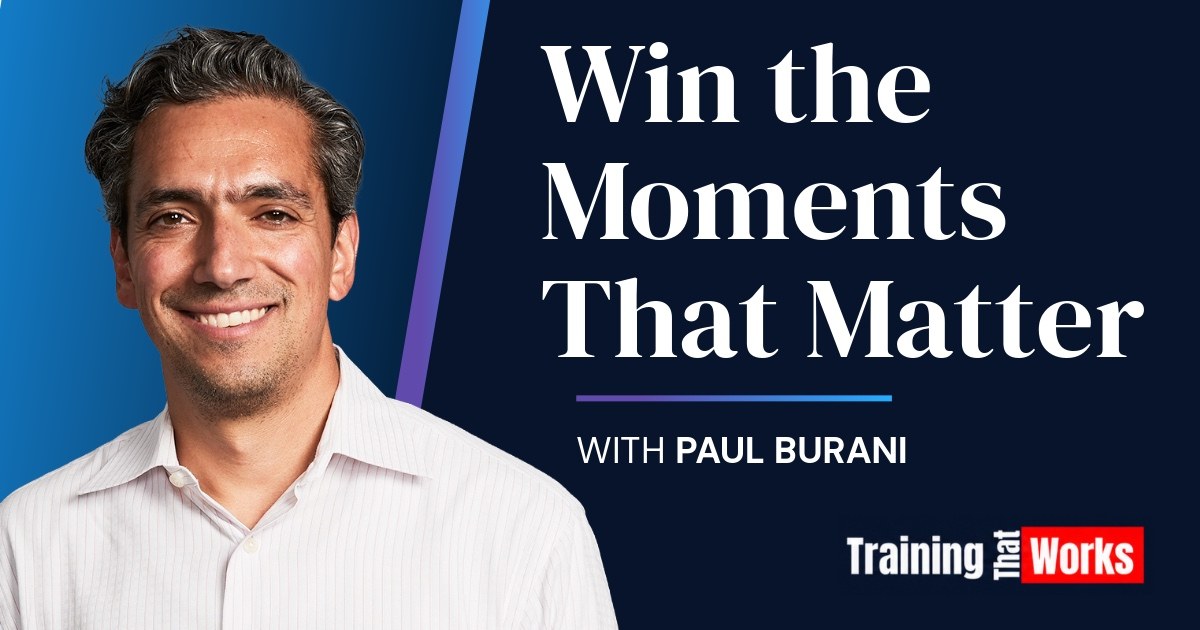
Rustin Schroeder · 00:00Welcome to Training That Works. My guest today is Paul Burani, co-founder and chief revenue officer of Atlas Primer. Paul started out as an analyst, then he founded a digital media agency and sold it. Then spent six years at Google. Leading global partnerships and vertical strategy. He later moved into ed tech, focusing on economic mobility. Today, he's building a platform that uses AI to help people rehearse the conversations that matter the most. The stakes, the high stakes ones, where being human is the entire job. Paul, welcome to the show.
Paul Burani · 00:35Thanks so much, Rustin. I appreciate it.
Rustin Schroeder · 00:37Yeah, yeah. Hey, can you tell us a little bit about yourself and what you say to someone who you know, hey, what do you do for work who's outside the industry?
Paul Burani · 00:45Well, you know, I'm tempted to say it depends on how they feel about AI. sometimes people, you know, are gonna sort of filter their reaction based on what they feel about this, you know, burgeoning technology. But real simply, we help organizations practice tough conversations. as as AI is changing everybody's job and reducing it to a series of tasks, we know that Tasks can be automated, but a lot of them cannot. And that represents those human tasks that can't be automated, really represent the future of of our workforce. And so we want to help organizations adapt to that change.
Rustin Schroeder · 01:29Right, right. And I think that's that's really important because you're right, the the piece of the being human piece is gonna become more important than ever. And so love that. So before we dive into that piece of it, let's go back a little bit. when you built your first company, can you tell us something that you learned kind of the hard way that you wouldn't have learned had you just stuck with your, you know, regular job?
Paul Burani · 01:51Great question. probably too many to list in one podcast. But I think the one that comes to mind specifically my first go-around as a founder is just how hard it is to make it as a solo founder. I founded a digital media agency called ClickSharp, and I had my vision, I had my business plan and my my clients, and everything was pretty buttoned up. but without that. partner in crime without that person to basically you know a thought partner, somebody w with whom we can bounce ideas and and quickly get to the signal and tune out the noise. when you're stuck inside the echo chamber of your own head, you have to be very, very disciplined about how much to listen to every voice versus going with your gut. And so this time around, you know, I have a a Great co-founder, the founder and CEO of Atlas Primer, Hinrik is you know, he's been building for years, and we have a great sort of iteration on all of the ideas that push our business forward.
Rustin Schroeder · 03:01fantastic. So having that partner just really keeps you aligned and focused and moving forward. That that's that's actually really great advice because you're I mean, you're right. I totally understand. When you are solo, there's a million directions to go down. And you know, you can convince yourself that, you know, five twenty five of them are the right direction and then kind of play a little piece of each of them. So so when you were at Google, you said that Google's Learning and Development Organization was one of your like secret weapons. Can you tell us a little bit about that?
Paul Burani · 03:33Yeah, I mean I think an organization that prioritizes the development of its people is always really set up well in the long term. You know, whether or not you like the term human capital, some people kind of object to this idea of reducing people to capital, but there's a reason that term exists, because the our the human workforce is typically the largest item on the budget. Right? Payroll is a big investment, at the risk of stating the obvious. And it was there there were some unique dynamics at Google that I think make it especially germane to this conversation. Back in the day, Google was rewriting the rules of the modern workplace. They were a fun, dynamic organization growing by leaps and bounds, but doing all the little things to make it a really cool place to work, right? So not only just Putting amazing technology out into the world, but having really cool offices with bottomless snacks and fun work culture. And you know, the the Detroit office, which was the first one I ever saw, they had this slide that ended up in a ball pit. Nobody was doing that, right?
Rustin Schroeder · 04:44That's awesome. Right.
Paul Burani · 04:46But 25 years ago, give or take, they started to rewrite those rules and it it set the tone for a culture. And people would Bend over backwards to try to get their foot in the door. And what you had was a lot of people, I'm not gonna say overqualified for the jobs they took, but a lot of people used the the rationale. Hey, I just want to get in. The way it's growing, there's always gonna be opportunity. If I get in my my foot in the door and just establish myself, the sky's the limit. And that often meant that you had people that were very senior for the jobs they took. that were that had a lot of experience for the role that they stepped into. And you gotta give these people a path. You have to develop them because otherwise they get really, really restless. So, you know, you had a lot of talented people on the front lines of these positions, and and they a lot of them were actually in the L and D organization. So as people you know. Moved forward in their careers, some of them would join LD and bring those perspectives from the front lines to their work. and they took it to a new level. So measuring behavior change and business outcomes, there was a really innovative program called Project Oxygen, which was the first real human resource analytics endeavor of its time. Measuring through internal company surveys, they would sort of reverse engineer what were the practices of development of leadership, et cetera, that helped people achieve their best. And so what it did was it really created role-specific, contextually built experiences. And the outcomes were not just engagement, but it was really about judgment and practice and execution, which is all the same things we're talking about now at Atlas Primer.
Rustin Schroeder · 06:37Right, for sure. And I I when you mentioned the the cool things in the beginning too, I remember reading and one of the things I loved was that Google would allow like X percentage of time, I don't know if it was five percent or ten percent to devote to twenty that's unbelievably cool of
Paul Burani · 06:49Twenty percent. Yeah.
Rustin Schroeder · 06:52like your personal projects. Cause that's something when I was in the corporate world, I just w I had so many things I wanted to do to help the company, but they weren't exactly aligned with like ex you know, what you're supposed to be doing every day. But I think in the long run they could benefit. And I was just like, I love that idea of like Hey, you can if you have an idea, run with it. Use 20% of your time to build something for the company. I just I just thought that was a really cool idea. you mentioned rewriting the rules. Is there anything that you think companies are failing to do right now. They're still failing to copy it. Like they kind of rewrote the rules. Everybody kind of started copying what they're doing and seeing what they're doing. Do you think there's a a a pretty big market out there right now of people that are still failing to copy? And why do you why do you think that?
Paul Burani · 07:35Yeah, I think the the miss right now, Rustin, is the contextual piece of all of this. So too often the way these learning and development programs work is that there's a distance between the decision makers and the end consumers, those rank and file people that are tasked with doing the training. so right now it's too much check the box. It's too much. Email shows up in my inbox saying you gotta do this training by a week from next Friday. And implicit in that is you you don't want to be on someone's list when they have to like you know babysit us to get it all done. what we need more is learning in the flow of work. and that means rather than context switching and asking someone to put anything on hold while they turn their attention to this learning and development endeavor. What we need to do is really seize those moments at the point of the most relevance. So if I have a meeting and something about it doesn't go well, that is the moment, right? When I hang up the phone or close that Zoom window or whatever it might be, that is the moment to say, hey, this is an aspect of the call that could have gone differently. Here is a training that could work better. And if you got five minutes, do it right now, right? This is what You know, from our point of view, this is what's gonna change learning and development is if we are able to surface those opportunities at the moment that they matter the most.
Rustin Schroeder · 09:08Right. that it that's actually quite brilliant. I I like that. Cause you you're right. As soon as you are off that call or that, you know, thing happens you need improvement on, that's the time to learn is right there and go through it. I like that. so I mean that's more on the ed tech piece. after Google, you went right into ed tech to help people, you know, outside the traditional higher education path to help them. how did you find your way from Google into that line of work?
Paul Burani · 09:34Well, I wish I could say it was some inspiring bolt of lightning, but it's really kind of more like dumb luck. I think you hang around long enough in your career, everyone gets a little bit of dose of dumb luck once in a while. I knew for a long time that media and ad tech were not gonna be my life story. I got what I wanted from that experience. Now I didn't fully have it mapped out what I was gonna do next, but you know. Certain events happen that completely reshape your thinking and/or the world order, such as a global pandemic, right? And so in the middle of COVID, I saw an interesting trend happening. I saw a lot of people forcibly on the unemployment line for things that were far beyond their control. And it was raising the the sort of tenor of A discussion that we were having about in a as a society, about meaningful work and about you know, not just gainful employment, but work that allows us to be our best selves. And and along with that, exposing some fault lines in the pipelines between education and industry. So if we look at education as our farm system to take smart people and groom them to step into roles in industry and keep our economy moving forward. There's a lot of things that are broken in that equation, starting with the fact that h higher education has a very narrow view of the type of people that will thrive in that system. So I had a former colleague from Google. he was running the automotive business in the Middle East and North Africa region. And you know, I was I was in a role where I got to collaborate with all these great people. We stayed in touch and like so many people, you know, your your network follows you around and He was standing up a new organization within Udacity, which at the time was an independent company, today part of Accenture. and Udacity was was really promoting this alternative learning model to say, hey, look, the knowledge is out there, it belongs to everyone. What we're doing is offering it in this, what they called a nano-degree, like this short form format that would allow people to get the education without taking on the usual opportunity costs, right? Quit your job, go back to school, you know, miss out on earnings, that kind of thing. And they had done well at the consumer level. The enterprise business, B2B, was doing well, and the third leg of the stool was business to government. And so I was the first hire in North America to start building that business and really go directly to some of these huge government agencies and their ecosystem of partners to start really put moving the needle on this alternative model.
Rustin Schroeder · 12:16Okay. Okay. That that's very interesting. And then how did you then go from that to to Atlas Primer? And then I have some questions about Atlas Primer and and their their starting of of the company. I like that too.
Paul Burani · 12:28Yeah. how did I go from that to Atlas Primer? A lot of little steps in between. it's never a straight line, right? So I I made a few more stops in ed tech, you know, always working on that that core economic mobility mission, but sometimes more from a you know, a staffing angle or an HR and learning and development, whatever it might be. So picked up a lot of those perspectives, but ultimately I ended up consulting working as a a fractional CRO, as an advisor, a mentor, and specifically working supporting early stage companies, because I knew that if I got exposure to a lot of these, there's so much innovation happening on the ground level. And you know, if there was a product that I really liked and the market opportunity seemed well-timed and I liked the leadership team, hey, if all those things check out. That's as good an opportunity as any. And so that's how Hinrik and I found each other through a community called Future of Higher Ed. and it eventually led to an opportunity as as we saw, you know, the relevance of this product to our mission and and the broader market opportunity.
Rustin Schroeder · 13:39Right. that's fantastic. so Atlas Primer, they actually got started in Reykjavik and as an audio learning tool, right? For people who struggled with getting through material by just reading it. do you know how that idea originally came about?
Paul Burani · 13:54Yeah, so so Hinrik was working on voice assistance a long time ago, like 20 plus years ago.
Rustin Schroeder · 13:59Yeah. Wow.
Paul Burani · 14:02And you know, I mean this is people forget sometimes, like AI didn't just come out into the spotlight in 2022 with the release of Chat GPT. AI had been around since you know the middle of the 20th century. and so these technologies had been incubated for a long time. At the time that he was working on some of these voice assistants. He also noticed that students, the consumers of this technology, they wanted more accessibility. we know that there are visual learners and auditory learners and kinesthetic learners. And not only that, but context was another sort of overlay because some people want to study at their desk. Some people can't do it then, but they maybe have a long commute or while they're exercising or cooking dinner. And so the modality of the training, as well as the context of it opened up all of these opportunities. So he's playing around with Amazon Alexa and created this audio assistant. It was you know deployed to a small team, tested and iterated, and ultimately the the sort of founding vision was to convert course materials into an interactive, sort of like a podcast type learning experience. And when I first started using the product, I would, I would before I would take my dog out on a half hour walk every afternoon, I'd be like, all right, let me look at a list of topics that I've been keeping here. And so, all right, one day I'm going to learn how to cook Indian food. And on my walk with Lenny, I'm gonna come back armed with everything I need to know from which which ingredients to buy, do I need special hardware? what are the methods, etc. What are the things to watch out for? And you could learn anything. And if you have the time, you can do it. So that was the initial vision, and ultimately. It just became so much bigger as we started to realize that supporting the way people's brains are wired really is a Pandora's box of different opportunities to sort of test and iterate. But it was always about getting the very best human performance supported by technology.
Rustin Schroeder · 16:09Okay. Okay. And so you you've been there for about a year now or so, right? And then what was there something, I mean, you kind of mentioned it a little bit. Was there something that you saw that you're like, I want in. This is a company I want to be a part of because you mentioned you saw obviously you were c doing consulting and you were in these different groups and you saw lots of different companies. What was it in particular about this one where you're like, This is this has got something I I want in for this one?
Paul Burani · 16:35Well, I think it's those three things I talked about before, right? It's a visionary product, it's a it's a market embrace of that product, and underlying that a leadership team, which is, you know, poised to go the distance. if I was to put a wrapper around all of that, it was that that mission that I had been on for years prior, which was to really just empower people. So it at a moment when people are freaking out about what's AI gonna do to my job and my career. And they see, you know, the the the things, the the little ripple effects starting to unfold, they're inevitably looking for a reason to be optimistic. And what we're trying to do is give people a reason to say, no, you're gonna be fine. You need to shift your perspectives laterally, and then there's a whole new ladder for you to climb. And just invest in yourself, you can't go wrong.
Rustin Schroeder · 17:29Right. I actually really like that. A reason to be optimistic. I mean, that is, I mean, that that can be just alone. That piece of it is is absolutely huge. And you said you wanted to empower people. And you've described your mission as using AI identify, like to identify the most human skills. And then to make using AI to make people perform better on those skills. And as AI improves and as you guys improve, which human skills do you think become the most valuable?
Paul Burani · 17:57The harder they are for AI to replicate, the more valuable they're gonna be. so I think of, you know, real virtues, judgment. That's that's oftentimes that's where the first place my mind goes is judgment is is such a human thing. But you know, the ability to build rapport and and create a feeling of trust or affinity. you know, if you're in sales, you know that people don't buy from people they don't like. Right. So, like the ability to be liked, you tried farming that out to a bot. It doesn't work. So, you know, as AI makes all of you know, makes information and routine execution so much cheaper. and while it's also increasing the value, you know, at the same time, it's basically increasing the value of all the skills that feed into what I mentioned: trust and judgment and rapport. at that moment, the advantages shifted, right? So it's not about Do we have access to these tools? Everybody has access to the same tools, and the data underlying that is pretty much the same. So now the advantage comes from how do you perform? What do you do with those tools? Ask better questions, make better decisions, you know, support other people, get the most out of your organizations. That's what we're trying to help people practice. And you know, at the end of the day, we're hoping that it inspires some confidence so that anybody can. Go into a human interaction feeling like they are their best self. And I'm sure you know that feeling, right? When you do something unrehearsed versus going in knowing that you put in the extra practice, how big is that mental edge that you feel, right? You that extra skip in your step, knowing, hey, I put the time in and maybe I lost some sleep and maybe I got a little nervous about it, but I am better off. So that's kind of the the what we're trying to sort of wrestle with and and bring it down to the ground for people.
Rustin Schroeder · 19:51Yeah. Yeah. No, that I completely agree with that 'cause that's happened to me so many times, like especially like with public speaking. I've done it so many times and there's times when you've rehearsed it so much. It's a when you're up there, it's just a completely different feeling. When you know it, when you have the material down, when you've practiced it over and over and over again. And then the other thing is like building this podcast, it was like my first season. I was absolutely terrified. I mean, it took everything out of me because it was just like, you know, you weren't used to it. What what happened? You know, you just worry about so much more. So Yeah, those that that piece of it I think is is really huge. when you start working with an organization, what do you often discover that there people through the people and the leadership that you they didn't see coming? Like the leadership s looks at it and says, I didn't I didn't realize this about the organization. Is there anything that comes to mind?
Paul Burani · 20:38I think LD programs sometimes make the mistake of s certain assumptions. Sometimes leadership makes the same mistake, which is that people don't know what to do. more often than not, in my experience, people do know what to do. And it's more a question of how to do it under pressure. So, you know, a high performer, someone who looks like a high performer, might be just Compensating for a weak underlying process by improvising. And in in the world of sales and customer service, this is a golden skill, right? The people that are have the ability to think on their feet and improvise, they do very well. But if we if we met people where they were, we could get more out of that skill. At the same time, I'm talking that's that's like the rank and file. Then you've got the managers. a lot of managers are avoiding difficult conversations for for the reason that a lot of them lack the confidence. A lot of managers don't have that experience and shy away from acquiring it. and that's very different from lacking empathy. And then you go even higher and higher up. And really, the I think the thing that the leadership teams miss the most is that some of those most consequential, teachable moments. They're happening in the minutes and seconds. They're happening in contexts that no one has trained for and no enablement team or learning and development team could ever anticipate. it's really just like it it it's just in the flow of daily work, which is something we talked about earlier
Rustin Schroeder · 22:25Right. And I I really like that 'cause I I completely agree. And especially like the part that really hit with me was like, okay, you don't have the conversation because you haven't practiced it and you're not comfortable. It's not something that you normally do. So you kind of avoid the conversation. And then so it it either doesn't happen or it's pushed back so far that is it even worth it to have it anymore because it's you know, because whatever the issue was is is too far back. So Yeah, I I think that's really important. And and speaking of the training, can you tell us what's the best training that you've ever had?
Paul Burani · 23:00I'm gonna assume you mean in a structured environment versus you know the the trials of
Rustin Schroeder · 23:03Yes, in structured and L and D world.
Paul Burani · 23:07raising children in the digital age, or you know, those are good trainings too.
Rustin Schroeder · 23:10that yes, those are too for sure.
Paul Burani · 23:14in a in a corporate environment, you know, one that always comes to mind for me, Rustin, is is I took a training at Google called Leadership Impact and Presence. it was, I believe, a four-day training. So it's a pretty big investment. And when you think about the opportunity cost of taking 40 leaders, putting them in a room for four days, is a lot riding on it. What I think they did really well was reset expectations at the start. So you know, leaders, especially companies like Google, leaders come in with a lot of that momentum. Well, I got to where I am because I did well. You know, for a long time and I've built on my progress. And we came into this environment and they basically said, let's just all come at this like we're a blank slate. Let's throw away our assumptions of what makes a leader or what leadership is or what it isn't. And let's just break it down to who are we as people? What are our tendencies? What are the the you know things we know we're good at? What are the things importantly that we know we're not good at? And applying some often, you know, very tried and true principles to an open mind is a whole other like it makes a whole world of difference. So we spent about a day clearing our minds of all that baggage, and that made the other three days so much more effective. Yeah.
Rustin Schroeder · 24:37That's a great idea. yeah, yeah, absolutely. I can't yes, because you're right. We come in with all these assumptions about what this is, what it's supposed to be, what you're here for. You know that, but clearing all that beforehand, I think, is is absolutely brilliant. So I I love that. Thank you for sharing that. and on the flip side, what's the worst training you've ever had to sit through?
Paul Burani · 24:59You know, it's not always hard to remember them. That's probably because they weren't great trainings, right? I think I've had a lot of product trainings that are very technical where, you know, and when you work for technology companies, right, they're iterating constantly. There's features, there's new positioning, etc. But a lot of times it it's moving so fast that the training becomes an extension of that neurosis where it's just like, all right, this has shipped, we're gonna focus on information transfer. Let's get it out of the heads of the engineers into the product managers and then out of the heads of the product managers into sales. And that's different than practicing what to do. you know, more power to them. Like the they'll step back. And and the creators of these very technical product trainings, it's a hard job. So I don't want to undermine anyone, right? But it's a hard job. But I think what often happens is it's very tempting to say, okay, if you know the following things, you Are now an expert. You are now certified. when the reality is it's more about being able to summon that knowledge prompted by external circumstances rather than here's a question, either you're in or out. It's more about like, can you can you think on your feet and improvise? We talked about that earlier.
Rustin Schroeder · 26:18Yes. Yeah. I I I like that. And you one aspect that you mentioned a few times is like sales and you facilitated, if I remember correctly, you facilitated a training at Google like on persuasion and storytelling. Can you tell us what do you think most people misunderstand about what actually persuades someone?
Paul Burani · 26:40Yeah, when we think of people that are persuasive, I think it's very tempting to say, that's like the hard sell. That's the person who won't let you hang up or won't leave your front door. so I think a lot of people feel that persuasion comes from making a stronger argument, but really in practice, the strength of persuasion is rooted in this foundation of understanding the other person's priorities, their fears, right? What motivates in them or incentivizes them? and and really even like their identity? What who are they? Who who do they wanna be? We used to always talk about how in order to really develop a champion that you can work with throughout a complex sale, you wanna always be thinking, How do I help this person get promoted? Right? How do I How do I motivate them to sell on my behalf when I'm not in the room? And that requires a real character study. So I can be persuasive using perfectly normal everyday language if it's language that is tailored to what I know are their, you know, wildest dreams.
Rustin Schroeder · 27:50Right. Yes. that absolutely helps. Thank you. I think I think that's really important. spe and what would you say is your favorite business book? One that kind of genuinely changed the direction of how you think?
Paul Burani · 28:04you know, there are a number that come to mind. I think, you know, context is everything. I there are some books that I go back to over and over again because I appreciate that if my mind has evolved in the last year or two since I read it, I'll get something new out of it this time around. So there's a book called Made to Stick by Chip and Dan Heath. The Heath brothers are well-known authors, they've now Written a bunch of books together, but I don't know if this was the first one. It was my first one. I read it back during my ad agency days when, you know, ideas were our currency. And made to stick is all about getting your ideas to be stickier so that you are harder to ignore, you're harder to forget. And it's very practical principles that I actually use them as much in my personal life. you know, when I'm when I'm trying to get my kids, for example, to understand my point of view around what is excessive screen time. Well, I learned there are some ways to do it and there are some ways not to do it. And I that's a perfect illustration. Like you go back to that book, I highly recommend it to all your listeners. it's it's one that I think a lot of you will go back to over and over again.
Rustin Schroeder · 29:20Right, that's a great reminder. Absolutely. That is a book to go back to for sure. and you mentioned some personal stuff. What would you say is something that most people don't realize about your journey?
Paul Burani · 29:32Hmm. Well, I don't know if I'm you know special in any way, but I think in general, we just tend to forget how much people screw up on their way to success. and so, especially in this world of social media, right, where we we are all we all present ourselves in the best possible, most favorable light, but we also expect everyone else to show up that way. I very quick to remind people like how many failures I've encountered along the way and and importantly how those have helped me in unique ways that I couldn't have you know I couldn't have understood in any other in any other way.
Rustin Schroeder · 30:17that's that's fantastic. you drive, I think, a nineteen eighty nine BMW and you DJ on nights and weekends sometimes. why are those things important to you and and what would you what do they give you back that does that work doesn't?
Paul Burani · 30:33Hmm. Well, you mentioned my car. so yeah, I I love my little cabrio. it's you could call it maybe it was like a gift to myself to stave off midlife crisis. But if I'm being honest, I've always been an enthusiast. I've always loved cars. I somehow have passed that on to my son as well. And you know, cars today, they're they're basically glorified cell phones. and that's not That's not a problem. Cars have some amazing technology nowadays. But there was, there is this sort of we we've we've moved out of the era of yesteryear when you really were connected to the road. When it was one hand on the wheel, another hand on the stick shift, and every little lurch, every little minor movement, every bump was something that you felt. And I don't obsess over the physical world. I don't go out and like pluck. blades of grass or plant flowers. I do have a little herb garden, but I love the idea that there are still things in this world that are not reduced to ones and zeros that are atomic. and so when I you know it also I just think German cars in the eighties were like the pinnacle of automotive design. So makes me feel like a kid again. Same thing with the DJing, right? Like I live in a great community. We have lots of close friends here in the area. People like to have fun and people prefer that with music. So I record all my mixes, you gotta have something to play when I'm driving around with a top down, you know?
Rustin Schroeder · 32:02Right, right. No, I I I love that. And I love how you mentioned the physical part of the cars too, because you know, I used to drive a stick shift too. And there was the the different you the things you hear, the things you feel on the road, it just all made a difference. And now, like when you mention that, I think I never think about that ever now. you know, it's just something that's taken care of for me. So
Paul Burani · 32:19Right. You don't need to.
Rustin Schroeder · 32:22you don't need to, but you're right, there was something about that that just felt right, you know, that that having that physical part. So thank you for sharing that. That that's awesome. A as we close, is there any final advice you want to give leaders who are trying to make training and growing their organizations work?
Paul Burani · 32:40Yeah, I mean, I would say start with the moments where you know performance really matters. that's an abstract idea, but if you really kind of separate like those those seminal moments that move the needle and work backwards, design training around those moments and give people a chance to practice and and really interact with those situations. You can only usually do it once in real life. I like to joke that you know any any star basketball player doesn't go into game seven of the NBA finals, you know, asking for the ball at crunch time without having shot 2,000 jumpers that morning in the gym. You gotta give you gotta create the space to give to to to to simulate these situations so that when it is actually crunch time. They're not doing it for the first time. They're doing it for the 500th time. And that is hyperbolic for a reason. They should be able to make mistakes safely, get feedback, try again, constantly iterate. So training is not really just about helping people know more. It's about helping them communicate, make decisions, perform better when those stakes are real. I'm always happy to talk to people about you know, just our ethos. you know, we we like to nerd out on on training theory and You could certainly find me on LinkedIn, or you know, you can always check out Atlas Primer. it's atlasprimer.com. Made it real simple.
Rustin Schroeder · 34:08All right. Well, fantastic. Thank you, Paul, for joining the show. It has been great to have you here. There is a ton of gold in this podcast and I'm I'm really glad that you came on. So thank you for joining.
Paul Burani · 34:19Well, I appreciate the invite and I appreciate your work and what you do for this important topic.

 Apple Podcasts
 Spotify
 Amazon Music
 RSS Feed