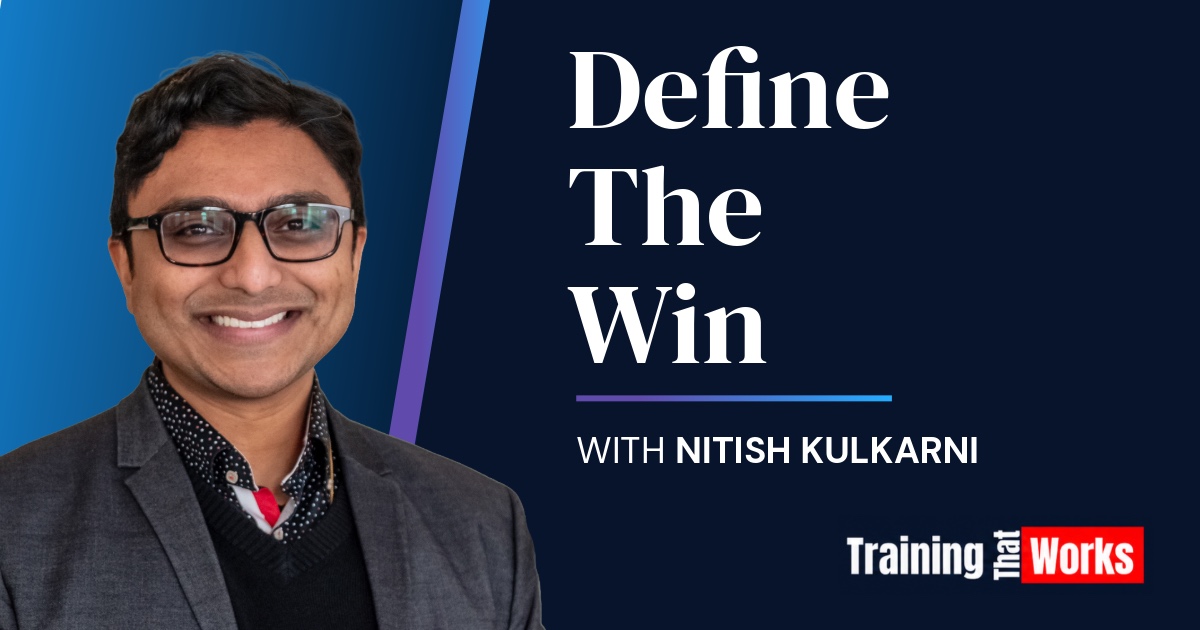
Rustin Schroeder · 00:00Welcome to Training That Works. Today's guest is Nitish Kulkarni. He is the Director of Training and Communications for Sales at Sweetwater Sound. Nitish, it is an honor to have you here. How you doing, sir?
Nitish Kulkarni · 02:25I am doing so well, Rustin. Thank you so much for having me.
Rustin Schroeder · 02:28Hey, no problem, no problem. If you could, could you tell the audience a little bit about who you are and kind of what you do?
Nitish Kulkarni · 02:35Yeah, absolutely. So as you mentioned, I'm director of training and communications here at Sweetwater. For those that might not know, Sweetwater Sound is the country's largest online retailer of music instruments, pro audio equipment. And now we've gotten into a bunch of other kind of adjacencies as well, band and orchestra, both sales and rentals, home audio and commercial audio and all kinds of fun stuff. So I have the pleasure and privilege of being the guy that gets to direct all the training operations here and so everything from our onboarding all the way through our continuing education, in-person training, digital training, certifications, vendor relations, I mean you name it, it all kind of rolls up under me and my team and so yeah so that's just a little bit about what I do. Our sales team is 600 strong now and growing by the day and so that keeps us pretty busy. There's lots of training needs.
Rustin Schroeder · 03:31Yeah, absolutely. 600 Strong is incredible. And I can testify to this company, Sweetwater. I actually purchased a microphone from them 25 years ago. And back then the experience was so good. I was like, okay, now when I purchased the new one in 2025, and I just was like, it was still just as impressive as a company. You guys really seem to care about the customer. like that experience, you don't get anywhere else. So I'm excited to kind of dive into how you do that, how you create that culture inside your company and what you're doing and training. So congrats, because it's just an awesome company and I've been really impressed with it. So it's really an honor to have you here.
Nitish Kulkarni · 04:12Well, thanks so much and thanks for all the business. I didn't realize you'd been shopping with us for that long. That's awesome.
Rustin Schroeder · 04:18Yes, yes, they actually still had the order. I had the guy pull it up and you know, earlier this year, I said to him, hey, can you check and see if my order is still there from 20? You know, it like, it was literally 25 years ago. And I was like, there's no way he has it. And he was able to find it. couldn't believe it. So it was crazy. So yeah, so hey, let's dive into training a little bit. What's the best training experience that you've ever had and what made it great?
Nitish Kulkarni · 04:34There you go. Yeah, that's awesome. Yeah. Man, you know, in, are a couple that I can think of. And I think in, in general, when I think about, the best trainings, there are definitely a few common traits that they all share. one is I think storytelling, you know, we learn so well through.
Rustin Schroeder · 05:03you
Nitish Kulkarni · 05:05telling stories and stories are how people are able to relate and thereby how we are as trainers able to make things relevant to people. know, some of the best trainings that... you know, that I can remember are ones that, it may not have even been labeled a training per se, but somebody getting up in a meeting and just having something to share that was, meaningful and relevant and well-timed. And, and suddenly you have this, this moment of like, wow, I've never, I've never thought of it that way. Or this is phrased in a way that was really, pertinent to, to either what I'm going through in, in my job or, projects that my team's working on or whatever the case might be. Right. And. And so those are some of the best trainings. even if there isn't... You know, stories don't don't all have to start with once upon a time, right? So so storytelling, I think, is a mode of operation for some people, and they do it really well. And this professor in college, I took this class called Music and Mathematics and and fascinating class. And it was basically just anything to do with music and mathematics. And if if if a given topic was at the intersection of those two things, it was fair game for our class. And so we covered all sorts of different things, you know,
Rustin Schroeder · 05:56Exactly.
Nitish Kulkarni · 06:25acoustics, know, in concert hall design and how geometry can actually be imposed on musical progressions and all kinds of zany stuff. Some of it was a little out there, but this professor, I'll never forget, every class with him was such a joy because every lecture was like a TED talk. And he would come into class and he would start the class, you know, by writing something outlandish on the board, some thesis. And then he would say, okay, this is what we're going to talk about today. And then his very next sentence, he would go somewhere completely different. And then you're kind of like following along and like, like was like clockwork at the end of every 60 minute segment, he would end back up where he had started. And it was just this like Eureka moment every time, you know, and I just people like that. I mean, his, wasn't really a
Rustin Schroeder · 06:47Okay. Hmm. Wow.
Nitish Kulkarni · 07:14I don't think if you asked him, he would say that I'm a storyteller, but the way in which he taught was through storytelling. You know, and if I just think back to my best teachers and professors and then later on in kind of the corporate training world, the people that have always nailed it, I found are ones that can get their message across through storytelling and good oration. That's really what makes great trainers.
Rustin Schroeder · 07:20Right. Right. Right, for sure. No, I like that a lot and completely agree. It's like when you're in a training, you're hearing a story. It's like suddenly the time, you you're not really paying attention to the time anymore. But when somebody's like lecturing, it's like, all right, I've got a million things to do. When is this going to get over? But yeah, once you start adding that story element to it, it really does change everything. So what do you what do you do? Do you incorporate storytelling at? You know, at Sweetwater, how does your training system work and what does it kind of look like? We'd love to hear about that too.
Nitish Kulkarni · 08:06Yeah, that's a great question. you know, training takes a lot of different forms here at Sweetwater. So one of them is onboarding. We have our flagship onboarding program is called Sweetwater University. and Sweetwater University has been in, you know, in and around, our company for a very long time coming up on three decades now. And in its current form, it's actually a 13 week onboarding program that each of our salespeople go through. So if you're hired as a sales engineer at Sweetwater, you go through this three month long training and in those 13 weeks our new hires will take about a it's about 350 classes with about 130 different instructors that come in and cycle throughout this program. Yeah it's pretty robust that way and we cover lots of different things there's obviously technical training you know we sell all sorts of products in the MI or music instrument and pro audio space and so there's a fair amount of like music technology that you have to understand in order to be able to qualify customers and sell the right stuff. But then there's also a pretty complex. suite of software that powers this whole place, know, our CRM and some of our other internal proprietary tools. so some of our training also focuses on just understanding our systems. How are you going to get through, you know, email, which I know you're passionate about in particular, and, and just the phones, you know, selling over the phones and kind of using all of our, inventory management system and our CRM and so on. And so we have systems training and there's like sales process training, right? Like we follow what I think is pretty,
Rustin Schroeder · 09:26Right.
Nitish Kulkarni · 09:42what I think is pretty... or maybe a familiar sales process if you've been in sales before, but we of course put our Sweetwater twist on it and the way in which we kind of think about customer centric selling over the phone in kind of a specialty retail context. We've over the years kind of developed a special formula for our sales process and so we teach that. And then there are just like kind of broadly speaking Sweetwater culture classes, right? New hires go through department rotations with heads of different departments so they understand how does our marketing
Rustin Schroeder · 10:11Mmm, okay.
Nitish Kulkarni · 10:16team work and how do logistics flow in the warehouse and so on. And so there's all kinds of different types of classes. And so some of the technical classes, like, you know, at some level, you just have to understand basic electronics and signal flow and audio systems and so on. But I think where storytelling really becomes an effective method of instruction for us is many of us, myself included, have been sales engineers here. So we've gone through that. We've had our own experiences, things that have worked for us, things that haven't worked for us. And then some of us have entered the training space. And so our ability to relate very directly to the new hire in terms of here's this job that you're about to go do, to further kind of...
Rustin Schroeder · 10:45Okay.
Nitish Kulkarni · 11:06make that, you know, increase the gravitas of that, guess we could say. They are fully commissioned salespeople. And so, you know, what I'm teaching you is not just like nice to know or even need to know for your job, but like literally is going to help you put food on the table, you know, when you're in commissioned sales. And so being able to relate to that, you know, what, my early experiences were as a sales engineer, I was in that role for over five years. And so, but I still remember, you know, being a young sales
Rustin Schroeder · 11:12Okay. Exactly.
Nitish Kulkarni · 11:36engineer and some of the challenges that I faced, how I worked through them, and now I get to train other people on what might work for them. And I always tell them, you your mileage may vary. This is one person's experience or one person's story, but being able to share our experiences and talk about them honestly and teach through that lens, I do think is useful and that's where think where that storytelling angle comes into play.
Rustin Schroeder · 12:03Right, for sure, for sure. Would you mind sharing briefly, kind of like, I love that you say you were a sales engineer for five years and now you're, I mean, you're the director of training and communications for sales inside of Sweetwater, which is obviously a massive role. How did that look? How did you get there and what did that look like?
Nitish Kulkarni · 12:21As Steve Jobs says, you can only connect the dots in reverse, right? And so definitely was not on my bingo card last year, so to speak, I was asked to take this role. But looking backwards, it kind of makes sense. So when I was a sales engineer and I rolled out, rolling out is kind of what we informally refer to internally as the process of kind of graduating from the training program and starting your work, right? So this was 2017 when I was going through that. then even as a sales engineer, kind of... was looking for opportunities to get into peer leadership, mentorship, that sort of thing. I liked mentoring new hires even as a sales engineer. So anytime somebody new would come along and I would get to know them if they had questions about the process of getting their business started or just the process of phone sales and so on. mentoring people as much as I could then. I actually... probably annoyingly so, knocked on the doors of our sales leadership and said, you know, when can I, how can I get involved? How can I help teach classes or whatever the case might be? And actually the first time I was invited to be a part of Sweetwater University from the instructor side, speaking of storytelling, it was actually an open panel where they had invited three sales engineers from various tenures. I kind of represented the youngest tenure, but we had sales engineers that had been there 10 or 11 years. one that had been there 15 to 20 years. And we had this panel kind of go in and talk to this group of new hires about what life is gonna be like as a sales engineer. And that this really is a career job. could be somebody that's been here 15, 20 years and that sort of thing. And that was kind of my earliest experience actually being an instructor. I always kind of had that bug. I was always the one in high school or college that led study groups and tried to organize kind of different get-togethers for studying and that sort of thing. And so I'd always had that kind of bug, I think, but it was the first time here at Sweetwater where I did that. man, that was such a, there was so much joy and fulfillment that I found from, you know, being able to... talk about my experiences in a way that might help others have a smoother experience, you know, as they were getting their careers started. And so truly those were some of my most fulfilling moments, you know, in the role when I actually was able to step away from the job I was doing, from taking care of customers, think a little bit about what's working for me what's not, and then kind of synthesize that into a package that I could then...
Rustin Schroeder · 14:37Right.
Nitish Kulkarni · 15:01put in front of new hires and maybe help them. And so after doing that role for about five years, I had a stint for about two years. in sales management. And so I had a team of sales engineers reporting to me that we're doing the same role that I had been doing. And then even as a sales manager, I was expected of course to contribute and teach some classes in our training program, which I loved doing. so now that when I was in management, I was able to kind of increase my course load and so on and so forth. So when this position became available to kind of lead all of our training efforts,
Rustin Schroeder · 15:11Okay.
Nitish Kulkarni · 15:35senior leaders came to me and said, you know, we kind of have you in mind for this. Is this something you'd be interested in? And of course it was like, put me in coach, you how soon can I get started? It was very, very well aligned with my interests and just, you know, I love teaching and I love the process of learning and so on. so being able to this role a little over a year ago now has just been such a joy.
Rustin Schroeder · 15:43Right, right. Yeah, that's great. And I love how you said you went to your management and you would go and you would ask and you would ask, hey, when can I get in this? When can I start? Is there anything I can teach? I just, I love that because that's such a huge piece of it. And obviously they had you in mind as you, you know, as you went up in the company that, okay, this person cares and he wants to do this. So that made it an easy, you know, this is someone who really cares and is excited. And I think a lot of people miss that piece of it, just that asking. So I think that's great.
Nitish Kulkarni · 16:26Yeah. Yeah. Yeah. Thanks. Yeah.
Rustin Schroeder · 16:32So what's the on the back on the trainings like what's a bad training that you've had like what's the worst training experience you've ever kind of been through and what it made it so terrible.
Nitish Kulkarni · 16:41I can think of a few that have left something to be desired, shall we say. I think if I think about those as well without naming any names, I think there's common traits there too, right? And it's usually when the person who's presenting or leading the training doesn't really understand their audience, right? Because...
Rustin Schroeder · 16:49Okay. Right.
Nitish Kulkarni · 17:07Like now my team and I, work a lot on digital training and something that we did from the very beginning that I'm looking back actually really. that we had the foresight to think through this, but every digital training that we produce, we put learning objectives at the beginning, right? By the end of this course, the learner will dot dot dot, and there's like three or four bullet points. And it helps us stay organized because it allows us to tie back at the end of the course when we're doing peer review. We ask, okay, well, I walked through the whole script for the module. Did I actually cover what I said I was gonna cover?
Rustin Schroeder · 17:42Right.
Nitish Kulkarni · 17:42seems so obvious, but defining the win condition at the beginning and then kind of reverse engineering it so that you end up talking about all the things that you said you were going to talk about. is so important and as obvious as that is in digital training and that sort of thing, we oftentimes miss that in in-person training, right? And we tend to think of it like, okay, well, I know the subject matter really well and I can get up and I can present this slide deck and if somebody asks me questions, I'm qualified to answer them in real time.
Rustin Schroeder · 17:54Absolutely.
Nitish Kulkarni · 18:13Are we really defining the win condition? Like what is it, if I put myself in the shoes of the trainee instead of the trainer for a moment, when they leave that room, are they going to have taken away a nugget? Are they going to be able to apply something to their job right away? Are they going to understand why they were invited to that training? And so if I think about some of the least effective, I'll say, trainings that I've been part of, they have been... they have been when the presenter, think, misunderstood the audience a little bit. I'm guilty of that too. I am asked sometimes to come and lead trainings and I find if I don't quite know who I'm speaking to and I can't tailor my message to them, then I'm worried that it's not gonna be as effective as it could be, right? And ultimately, I think one of the best byproducts of training is that it should inspire, right? Like this feeling of...
Rustin Schroeder · 19:04Right, love that.
Nitish Kulkarni · 19:09learning something or becoming better at something, upscaling. It's a very, Hardwired human tendency like we want to get better at things. We want to learn things even little kids You know, they're always poking around trying to learn the environment around them. We're all born little scientists, right and so being able to tap into that and and kind of spark that inspiration I think is is where the missing ingredient is sometimes sometimes I've also left trainings that were like Technically great maybe even maybe even profound but then leaving them I didn't feel inspired. I felt like I learned something but I wasn't, you know, I wasn't inspired to action so to speak and you can't you can't manufacture inspiration maybe every single time but but that perhaps ought to be the goal.
Rustin Schroeder · 19:49Right. Right, right. No, I really liked a few things you said there, especially like knowing who your audience is, because that's key. I mean, because sometimes people come in and they don't, that's clear. That is kind of what makes a, for a really bad training if they're talking to the wrong group about the wrong thing. And then learning objectives. And I love how you said win condition, know the win condition. I actually haven't heard that before and I really like that phrase. So what is the win condition? That's great knowing that. And the last piece of what I really liked you said there is the inspire piece, because I completely agree.
Nitish Kulkarni · 20:12Yeah. Yeah.
Rustin Schroeder · 20:27I mean, you can have a training that's good, but when it inspires you to change like, hey, this is something that I can do, that belief and that inspiration that, hey, this is going to make me better. It's going to do this. It's just, it's such a difference. love that. So thank you for sharing that. I really liked that. Yeah.
Nitish Kulkarni · 20:42Yeah, yeah, you bet. You might hear a win condition referred to sometimes as a success metric. Same thing. I think you ought to know if this was successful or perfect or effective or meaningful or what, insert adjective here, if it was that thing, what would it look like? Well, then just go do that thing, right? And it doesn't have to be too much more complicated than that, perhaps.
Rustin Schroeder · 21:02Right.
Nitish Kulkarni · 21:06And you said, as you were reflecting back the piece about inspiration, I mean, think that's really what it is. Some of our best received training, find, regardless of what the learning objective is that we might have stated at the beginning, but why it's really effective is because it boosts confidence. We're in a... we're in an environment where we're talking about technical selling, right? Like even the position is called sales engineered Sweetwater because it's part sales part kind of engineering. Like you have to engineer these solutions but there's a limit to how many. technical things a salesperson can just recite off at the top of their head. mean, Sweetwater now carries over 85,000 products. So knowing everything about all of them, that's just even trying to, if that was my goal as director of training was to educate everybody in all the products, that would be an exercise in, in fertility, right? Like that's, that's not really going to happen, but some of the best service or support that I can provide to our sales team is when they leave a training, if they feel a sense of boosted confidence, like, okay, I got that, right? I can talk about this. I can think about the right customer to say that thing to, we actually find the biggest bumps in sales that follow a training in a given topic come when the salespeople feel, confidence boosted from that training, even more so than the specifics of the technical aspects. but it's more about the feeling that they walk away from, which, that sales 101.
Rustin Schroeder · 22:18Mmm. Mmm. Sure.
Nitish Kulkarni · 22:41right? gotta, it's transfer of enthusiasm, so they gotta feel inspired to transfer that enthusiasm.
Rustin Schroeder · 22:46Right, exactly. So based off of kind of everything that you've done and you've seen, what's working best or what are some of the main things that are working in training right now that you think are kind of changing the landscape or that are really working better than regular things that have traditionally worked?
Nitish Kulkarni · 23:05Yeah, great question. I mean, I don't know if I can speak for all training and development people out there, but I'll tell you what's working for us. So two types of training, right? There's just in case training and just in time training. So you think of just in case training like. basically what the public education system is, right? We're gonna teach you all these things because maybe someday somebody will ask you what the quadratic formula is and hopefully at that time you remember, you know? And it says nothing about access to that knowledge, right? Like is that person actually going to be able to recall those things, you know, when they need them? But it's more of a, it's more of a, we're gonna cover our basis kind of training, right? And let's be honest, like some training needs to be that way, right? If we think about onboarding training, there's a certain amount of things that you have to understand as a new hire at any organization. Like you gotta understand how does that organization deal with its time cards, right? Are you expected to clock in and clock out? Do you have to submit a weekly time card? What is the email etiquette at your company? What is the schedule? Like there's certain things that just have to be covered as part of onboarding. which are just in case, because you're probably going to need to use those things all the time. And we do that too. Like in a 13-week training program, there's a lot of just in case training. Just in case a customer asks you about this when you're on the phone someday, you need to know how a microphone connects to a mixer. OK, so that's just in case training. But then there's just in time training, right? Which is, ideally, when a customer asks you something that you don't know the answer to, in a perfect world,
Rustin Schroeder · 24:22Right. Right.
Nitish Kulkarni · 24:47somebody from the training team would materialize at your desk and give you the answer on a handwritten note, right? Like at that exact moment. That's like the ultimate just-in-time training, is also not realistic in every scenario. And so if I think about what are the differences, pros and cons between these two, just in case is necessary sometimes, but it produces a lot of what I was...
Rustin Schroeder · 24:51Right.
Nitish Kulkarni · 25:09what I heard referred to recently as training scrap. I was talking to another learning and development person in the music industry and he was talking about the concept of scrap in training being kind of similar to lean manufacturing. We want to reduce waste and we want to be able to reuse things and just get more lean with our manufacturing practices. And so he said, if somebody sits through an hour long training and they're only able to get about five minutes of usable.
Rustin Schroeder · 25:13Mmm. Hmm.
Nitish Kulkarni · 25:34learnings from it. That's 55 minutes of scrap. That's an expensive hour, you know, because a lot of it was wasted to heat, so to speak. You know, and so if I think about just in case training, it's just something that by its
Rustin Schroeder · 25:37Right.
Nitish Kulkarni · 25:47by its very nature is gonna produce some scrap, right? Because the whole thought process is just in case you need to know this at some future point, we're gonna train you on it now, but you may not end up needing it at all, right? We may be training on products that a salesperson isn't gonna sell for the next six to nine months. And if they don't remember what we taught them today, six to nine months from now, they might need another just-in-time training at that point anyway, right? So it's like, okay, I ended up just.
Rustin Schroeder · 26:03Right.
Nitish Kulkarni · 26:15Accidentally producing some amount of scrap on the other hand just in time training is logistically much more complex to pull off and it's difficult because You can't be at all places at all times, you know and And so something that I've talked a lot about with my team these days is okay. How can we come up with? A training intervention that's gonna be much more just in time rather than just in case for example If there's something that we need to train our sales team on, let's say it's information about a technically complex product or system. Well, one option we have is we could just make it part of our weekly training and train all 600 salespeople on it. But if we know that 90 % of our sales force is probably not going to talk about this product or this system in the next however many months, is it possible that we could
Rustin Schroeder · 26:50Okay.
Nitish Kulkarni · 27:10somehow using data science, find the right 10 % of people, just invite them into a room, go deep with the material, teach them everything that they're gonna need to know, answer all their questions about it. And the other 90 % of people, we can maybe give them that time back and invite them to some other training that's more relevant to them later. And so this is not, obviously it doesn't scale. You can't do this at all times of all days and do it for every training.
Rustin Schroeder · 27:17Mmm. Right. I like that.
Nitish Kulkarni · 27:35But we think about that balance between just in case and just in time. And as I think about this, even as a society, we're kind of moving to models in all aspects of our life where we are more interested in access to things rather than owning things. I mean, just 10, 15 years ago, I bought every new album that I was listening to. And now I pay my Spotify subscription. And so I pay for access to the music when I want it. don't.
Rustin Schroeder · 27:52Right. Agree.
Nitish Kulkarni · 28:03I don't really own it physically. And my generation and generations after us, I think, are not so bothered about owning things. As long as they can access them when they need them, they're good with the trade-off. And so we're kind of moving to a just-in-time society in all aspects of our culture anyway. And training is no different.
Rustin Schroeder · 28:10Right. Right, right, no, I like that. I really like the scrap piece of it too. That is very unique. I like that a lot. And that, so thank you. Thank you for sharing that. So, flipping into a little bit on your personal side of things, are there any like books that you really loved or recommended or inspired you, like business books that you could share with the audience that really you like or recommend others?
Nitish Kulkarni · 28:32Yeah. So one that comes to mind that I always have to call out is essentialism. Greg McKeon, I think is how you pronounce his name. Just such a great book. You when I was younger, was kind of, I'm talking like when I was in college, kind of always interested in this idea of minimalism. And, you know, can I just have less things? But then there came a point as I...
Rustin Schroeder · 28:56Mmm. Okay.
Nitish Kulkarni · 29:15grew up and I started earning and started creating a life for myself that I realized actually, you know what, I don't mind creature comforts. Like I want a nice car, you know, and I want to live in a nice house and I want to go out and eat nice food. then, you know, is that really minimalist, right? Am I really getting by with as little as I possibly could have? And it was when I found this book, Essentialism, that I kind of was able to, I felt like I finally found the right word for this thing that I'd been searching for all along, right? And it wasn't about just having
Rustin Schroeder · 29:45Right.
Nitish Kulkarni · 29:45less or doing less, it was doing less but better, right? Making more impact with fewer things and just reading that book and kind of listening to podcasts about it and Ted Talks and that sort of thing got me really to hone in on, okay, what's the most important thing right now? And that has helped me in so many aspects of my life, whether it's professionally or even in my personal life. In my job now, there's lots of different lanes shall we say that I'm responsible for. For example, I'm responsible for the onboarding, but I'm also responsible for continuing education. And so these different lanes of work that don't always talk to each other or overlap, know? And so if I'm thinking about my priority on any given day, I come into work and I'm thinking, okay, what needs my attention today? Where do I need to spend more time being creative or planning for strategic initiatives down the road? Or maybe today is just a day to roll up my sleeves
Rustin Schroeder · 30:19bet.
Nitish Kulkarni · 30:46and get my hands dirty with the work, you know, or whatever the case might be. For each one of these lanes that I'm responsible for, I think about having what he talks about as an essential intent in the book. So like, you know, if we were to just strip away all the specifics and all the particulars and the complexity that inevitably arises from having to do lots of things, like if we just boil it down to its core, like what is it really that we're trying to do? Right. So for example, with our onboarding program, I think, okay, I've got 13 weeks.
Rustin Schroeder · 30:58Okay.
Nitish Kulkarni · 31:16with every new hire to get them ready to be sales engineers. So what does that mean? When they roll out onto the phones, they begin talking to our customers on the phones and over email. They need to be able to adequately sell the products that we carry, but then they also need to be able to... create and provide really great customer experiences. They need to be proficient with our systems. They need to understand how to respond to emails quickly. so the more I list those things out, the more complex it seems to become. And so then if I have to simplify it, and essentially, what am I trying to do? Well, I'm trying to train them so that they can take great care of their customers, build systems that allow them to take great care of their clients. And by way of that, they're going to end up taking care of themselves and their families because they're commissioned salespeople. people. And so, you know, if I just, if I try to visualize in my mind's eye, what is the ideal salesperson is Sweetwater? Well, it's somebody that takes really great care of our customers and is able to provide a great living for themselves while doing so. Then that's great. You know, that becomes the compass and or the North Star. So
Rustin Schroeder · 32:05Right. Right, right, for sure. So speaking of like taking good care of your customers, how do you motivate people, especially new hires that you're not really sure long term what that's gonna look like. I you don't really know them very well as their new hires. How do you motivate them to have this, to always deliver like incredible customer service and to care about that piece of it? Because for me, that's always been like the hardest. How do you get someone to care about the customer service in that piece of that?
Nitish Kulkarni · 32:35No.
Rustin Schroeder · 32:51How do you do that at Sweetwater?
Nitish Kulkarni · 32:55Yeah, that's a great question. And if you ever find the cure for apathy, guess let me know because I could definitely use it. You know, the thing is, think, is it the John O'Leary quote that like, you you haven't fully lived until you've done something for someone that cannot repay you or he says it in a more elegant way than I'm recalling right now, but.
Rustin Schroeder · 33:17Yeah, something, yeah, right around, yeah, just like that.
Nitish Kulkarni · 33:21but, you know, you were talking about books earlier. The other book that, really made quite an impression on me was Will Godara's, unreasonable hospitality. Love that book. and, even though it's about, yeah, even though it's about food service, I mean, his point in that book is that we are all in some kind of hospitality, industry, right? Or, or hospitality is a part of our job, no matter who you are.
Rustin Schroeder · 33:29Yes, me too. Fantastic.
Nitish Kulkarni · 33:45some level and that was such an eye-opener for me and I really got to thinking like there is something really special about being able to take care of somebody at a really high level and just you know blowing their mind in a way like you know just doing something that they didn't expect at all and just going above and beyond and at Sweetwater we kind of you know our whole motto is doing that by just expansion of value right we just we give the customer so much more value
Rustin Schroeder · 34:01Heh.
Nitish Kulkarni · 34:14Just about anything that we sell frankly, you could go buy somewhere else. So then why us? know, what's the unique selling proposition and well, you're gonna get this person that is your go-to sales engineer and not a different person that you You you talk to every single time you're gonna get paired up with one person That's the one person you're gonna deal with a very human first model. We're much more You know relational sales and transactional sales So you're gonna have access to this expert who's kind of your guy or gal, you know on the inside and then by the way along with all that you're going to get access to the largest selection of inventory and the fastest shipping in the industry and then even after you buy the product from us you're going to be supported with post sales support for two years in-house and just all these ways that we give away more and more and more value.
Rustin Schroeder · 34:58Right.
Nitish Kulkarni · 35:02And so, if I think about what motivates the salesperson, I mean, when I was in sales management, I had this philosophy, I still have this philosophy that I think, and we talk a lot about intrinsic motivation versus extrinsic motivation in leadership. My philosophy is that all motivation is intrinsic. I think even if you say, I'm extrinsically motivated by, I wanna make lots of money because I wanna give away lots of money to charity, right?
Rustin Schroeder · 35:18Right, yep.
Nitish Kulkarni · 35:32That's my intrinsic motivation. That's a wonderful thing, of course, but I'd argue that it's still the feeling you get when you give to charity is what's really motivating. It's still an intrinsic thing, right? Which doesn't make it, which doesn't cheapen it. It doesn't make it.
Rustin Schroeder · 35:41right.
Nitish Kulkarni · 35:48you know, less meaningful or whatever, but it's just, is helpful to talk about it honestly, in terms of what it is, because once you realize, okay, well, all motivation is intrinsic, then as a manager or as a leader, or in my case, a director of like training, you know,
Rustin Schroeder · 35:53Right.
Nitish Kulkarni · 36:07interventions, it becomes about, how am going to tap into that intrinsic motivation? Well, with training, like I said earlier, the desire to learn and the desire to want to get better at things is intrinsically coded into us. know, and so, so if you can tap into that, then then I think you're better off. you know, that being said, there's all sorts of trainings all of us have to attend from time to time that aren't particularly inspiring in and of themselves like we were talking about earlier. But then there's different motivating factors, right? Like maybe you need to attend a training for compliance. Like that's to keep your job. You have to go through this training. Well, that's pretty strong motivator then, right? Or maybe the subject material isn't particularly interesting to you as an individual, but
Rustin Schroeder · 36:48Right.
Nitish Kulkarni · 36:58But you know that. there's going to be a customer for this product. And so therefore getting trained on this product is going to allow you to sell bigger systems or whatever the case might be, which means that you're going to make more money for yourself, which ultimately translates to security for your family, right? But then that's the intrinsic motivation. And so being able to relate to what is the thing that's actually guiding that person to want to get better at this thing, I think is critical for anybody that's in training is understanding, you know, what's in it for the trainee. And that doesn't
Rustin Schroeder · 37:20Mm.
Nitish Kulkarni · 37:30That's not a negative thing.
Rustin Schroeder · 37:33You
Nitish Kulkarni · 37:34None of us come to work because we're volunteering, right? Like it's okay to just say like, all right, I come to work and I do this thing for this reason. Well, great. Well, let me tap into that and remove pain points and make it easier for you. You're ultimately going to be able to take better care of your customers if you know this thing that you don't know today. And so therefore it's going to make for smoother operation. It's going to allow you to make more money for yourself or take better care of your customers. Happier customers are going to tell other people that could be potential customers. Your referral network is going to grow.
Rustin Schroeder · 37:37Right.
Nitish Kulkarni · 38:03Like all these things follow when training is in place, right? And that's that's kind how we think about it
Rustin Schroeder · 38:08Yeah, great. Well, thank you. I thought that was an absolutely fantastic answer. Loved it. So thank you. So what drives you? Why do you work as hard as you do?
Nitish Kulkarni · 38:14thanks. You know, as a training professional, think what drives me really is the light bulb moment, right? Like when it goes off in somebody's eyes and you can see that they've understood this thing and that's what got me attracted to training to begin with. And it's still what keeps me going is just, know, oftentimes at the end of my classes, I'll ask, did you learn something that you didn't know an hour ago? And if the answer is yes, then I've earned my salary for the day, I guess. But that's what it is. Helping others get better is so much fun, which ultimately, in this environment that I'm in now, like I said earlier, I'm helping. commission salespeople, right? Get better at things, which means that ultimately they're gonna be able to serve their customers better, make more, build greater financial security for themselves and their families. So there's like this really direct kind of connection from training to like people's lived experience. People have a better experience in a sales role when they get better training. so... having it be meaningful that way and impactful is definitely what keeps me going. And then, you know, as a musician myself, like if I wonder why do I keep practicing? Why do I keep writing music? Why do I keep rehearsing and performing? Well, it's because every day I feel like, wow, I've gotten a little bit better. And there's joy in that too, you know, like I think that the day that any of us feel like we've...
Rustin Schroeder · 39:56sure.
Nitish Kulkarni · 40:00we've arrived, right, or made it. There's nothing to get better at is the day that it's all over, right? So, yeah. And then what we said earlier about, you know, being able to deliver so much value or be so hospitable to somebody that really can't even repay you. There is something really inspiring about that. And so if you can tap into that and you can get people to create these amazing experiences for our future customers, then
Rustin Schroeder · 40:06Right, right.
Nitish Kulkarni · 40:30then that's such a magical thing, you know? So all those things that can keep me motivated every day, every day, you know, I am asking myself, okay, how can we make learning more fun? How can we make it more impactful? How can we, you know, reduce scrap and give people better and more content and less time? And, you know, how can I give them an actionable take away from every training that they go to? And we don't always get it right, but when we do, it's a magical thing.
Rustin Schroeder · 40:57Right, right, that's great. What's one thing about your journey that most people don't realize?
Nitish Kulkarni · 41:05Wow, one thing about my journey that most people don't realize, that it truly has not been, you know, that it. it makes so much sense to me, like when I look back at it, like, well, of course I went to college and I studied this thing so that I would get this job, so that I would get this promotion or whatever, but it has not been that way, you know, like it wasn't premeditated for lack of a better word, but I think the thing for me, like, you know, I studied music in college, that was my thing, and I didn't start off that way, I actually went to my undergrad as a business major, and later on, you know, found that I wasn't getting enough time for music, being a business major music minor. So I actually swapped that and ended up pursuing music full time. And every step of the way, for me, it was... Like I just lived my life by one principle, which was chase the music, right? Chase the music, like whatever the next thing is that is out there for me, I'm gonna find it if I chase the music. And that's honestly is what brought me to Sweetwater. mean, I was chasing the music, know, and the music led me here. And so at every step of the way for me, it's just been about doing what... gets me going, I feel passionate about. I find it very difficult to do things that I'm not inherently passionate about, which, if I wasn't, know, if training didn't interest me, I don't think I would be a very good director of training, right? Because it was just, I would be doing something that I don't find, I don't find, you know, that ignites that passion in me. And so, yeah, I think that's the common trade is if, and I tell people this too, like if you,
Rustin Schroeder · 42:39Right.
Nitish Kulkarni · 42:56if you pursue the thing that you're passionate about, things generally end up working out. that doesn't mean that, you know, I don't know that if I necessarily subscribe to... you know, do something that you love and you'll never work a day in your life. You know, I don't think it's, it's not that simplistic either. Like we all have days that are just tough days and you have to, you have to put in the hard work and anybody that does music professionally will tell you that being a professional, a, like a full-time composer or performer is not.
Rustin Schroeder · 43:18Right.
Nitish Kulkarni · 43:30There aren't days that feel like, wow, I'm not working because if I'm not working it's because I'm not finding work. That's a way worse position to be in. So yeah, so I think you have to find the thing that gets you going. But that may not even be something that's as obvious as, well, I love performing, and so therefore I want to go be a rock star. It's like, well, there's
Rustin Schroeder · 43:37You Right.
Nitish Kulkarni · 43:59There's a certain percentage of the population that will statistically be able to make it as a full-time rock star. But I think we simplify our dreams sometimes, right? Like maybe it's not as simple as saying, well, I love performing, therefore I wanna be a rock star. If you dig a little bit deeper, it's usually something else. Like, I love performing because I love being the conduit for the reason that somebody is experiencing a particular emotional reaction, right? Well, musicians have a unique ability to do that, but storytellers have a unique ability to do that too. And how lucky am I to be in a job where I can combine my love of storytelling and teaching and music into educating salespeople to
Rustin Schroeder · 44:29Right Right.
Nitish Kulkarni · 44:44sell musical instruments. I never would have been able to write that job description when I was in college or high school even.
Rustin Schroeder · 44:49Right.
Nitish Kulkarni · 44:52but it kind of brought all the right things together, right? So I think sometimes if we explore and examine our passions at a deeper level, we find that there are common traits between what really energizes us and what the world needs and what we can get paid for, you know, and find meaningful, fulfilling careers that way. And yeah, there's something out there for everybody. We just have to find it, you know.
Rustin Schroeder · 45:09right. Right, yeah, that is fantastic. And yeah, I think that is amazing too. Like the perfect career you found in this, you know, the training and the storytelling and the music piece that is so, you know, important to you is still there. And you know, you're doing all that at Sweetwater. I think that's incredible. So any final thoughts for leaders who are trying to make trainings work inside their business?
Nitish Kulkarni · 45:36Thank you. Yeah, think, yeah, it's a Bobby Knight quote, think. you know, everybody, it's something like everybody wants to win, but very few people want to prepare to win. You know, so like having a plan, like the first step in training is identifying knowledge gaps, right? So what do our people not know today that if they knew they would be able to produce, you know, fill in the blank, intended business result here. And so then how are we going to... bridge those knowledge gaps, right? And then come up with a plan. So let's say your organization is getting into a new vertical, you know, you're gonna be selling some new products or services that you don't currently sell. And so, you know, in order to experience... you know, business success or hit your KPIs or whatever the case might be. Like your salespeople are going to have to be trained in that, in that category. Well, then come up with a plan, right? So we think about every training program that we design. We think about it kind of like designing a curriculum, right? There's like a syllabus. There's, here's 20 courses that somebody's going to have to take to go learn everything that they need to learn from the basics of like, what is this cable, what is this microphone, how do I connect these two things together all the way to, okay, now I can design a recording studio, right? But there's a process involved there. There's lots of knowledge gaps that somebody would have to fill in. And so we are ultimately responsible for providing the path for all those knowledge gaps, right? And so I think my general thought there for anybody that's in the learning and development space would be, if you think about... any training that you are asked to provide ultimately exists to satisfy a business need, right? Or if it doesn't, then one ought to ask, well, do we really need this training? But assuming that it is a legitimate, you know.
Rustin Schroeder · 47:37Right.
Nitish Kulkarni · 47:43there's a legitimate business case for it, then what does success look like? What's your success metric? What's your win condition? And then reverse engineer it. Begin with the end in mind and say, okay, well, if our training knocks it out of the park, here's what the person leaving this training should be able to do. Or if it's a digital training, right? At the end of this training, the learner should be able to accomplish this. And then reverse engineer it to say, okay, well, were they actually able to do that?
Rustin Schroeder · 48:05Right.
Nitish Kulkarni · 48:10At some level, it's not that difficult. If we say by the end of this training, the learner will be able to define this term, well, somewhere in your training, did you tell them the definition of that term? And then were they able to apply it? And did you design some sort of knowledge check or some sort of other assessment where they were then able to answer a question where they had to demonstrate that knowledge? And so some very basic kind of learning principles.
Rustin Schroeder · 48:22Right.
Nitish Kulkarni · 48:39You know, one of this, I was listening to an interview with a scientist a while ago, Lisa Feldman Barrett, who's done some amazing work on, she's a neuroscientist, but she does some work on how the brain processes emotion and this kind of thing. And she was talking about, you know, the brain is a prediction machine, right? It is always making educated guesses based on patterns that it's recognized in the millions of micro-experiences you've had in your life up until this point. And it is constantly expecting something, right? It is guessing at what is the highest probability of what's about to happen and then confirming or having its expectations subverted. And sometimes we make prediction errors, right? Like we think something is a thing and then we get some new piece of information and we now have to assimilate that information and we realize that it wasn't what it appeared to be all along. And she said, know, she kind of jokingly says, scientists have a name for this process of making prediction errors and then correcting them given new information. That process is called learning, you know, and And I heard her say this in a Ted talk and I was like, that's so great. Like at its core, right? That idea of essential intent intent again, at its essential core, learning is just making prediction errors and then being corrected. And so we think about our training through that lens as well. And I encourage anybody in this space to do that. Learning often takes place because of the feedback that you are able to provide the learner.
Rustin Schroeder · 50:00Right.
Nitish Kulkarni · 50:25Right, so throughout the course of our 13 week Sweetwater University program, we have several dozen assessments that we give. I am generally speaking less concerned about what somebody scores on a given quiz or exam and more concerned about did this provide me and my team an opportunity to provide feedback and was that person able to then take that feedback and learn something from it and incorporate that feedback so they get better at it the next time. You know, nobody expects you to be
Rustin Schroeder · 50:25Right. I ain't. right.
Nitish Kulkarni · 50:55an expert at anything the first time, We all, an expert in any field is just the person that's made more mistakes than you knew were even possible to make, right? And learn from them all. So I think that that's what it should be. And so if you're designing trainings that are not maximizing the amount of touch points that you have to provide feedback to your learners, I think that's a really critical aspect of it, right? You can design the best training, but if you never have a mechanism to...
Rustin Schroeder · 51:03Right.
Nitish Kulkarni · 51:24understand did the person actually learn this thing or not, then that could be where a missing component is. so providing some sort of, it doesn't have to be a quiz, it could be some other task-based assessment or some real-world simulation where they have to practice doing the thing that you just taught them about. But in so doing, and your ability to observe how they are doing this thing that you just taught them, if they're still making errors, that will allow you to provide feedback and correct those errors. that correction mechanism is actually where the learning happens, not when we're
Rustin Schroeder · 51:53Right.
Nitish Kulkarni · 51:53lecturing and when we have fancy slide decks, know, so maybe that would be my final thought there.
Rustin Schroeder · 51:56Right. that's fantastic. Yeah. And I love all that too. mean, especially like knowing where your knowledge gap is for sure is obviously huge. And then, you know, that knowledge check and then being able to get that feedback and I think that's great. So thank you very much, Nitish for joining. Where can people find you?
Nitish Kulkarni · 52:18Well, they can find me just about anywhere. mean, if you go to if you go to Google and type in Sweetwater or Sweetwater University, you'll learn a little bit about our training program. And you can find me on LinkedIn. You can find me at nitishkulkarni.com if you want to check out music or other things there. so, yeah, so and I'm always happy to connect with people in the in the training and development space. Always happy to share thoughts and exchange ideas. And that's how we all get better. And we love getting better. So.
Rustin Schroeder · 52:47for sure. Well, thank you very much for joining the Training Networks podcast. It is a real honor to have you here, Nitish. So thank you for joining.
Nitish Kulkarni · 52:54my pleasure. Thanks for having me.

 Apple Podcasts
 Spotify
 Amazon Music
 RSS Feed