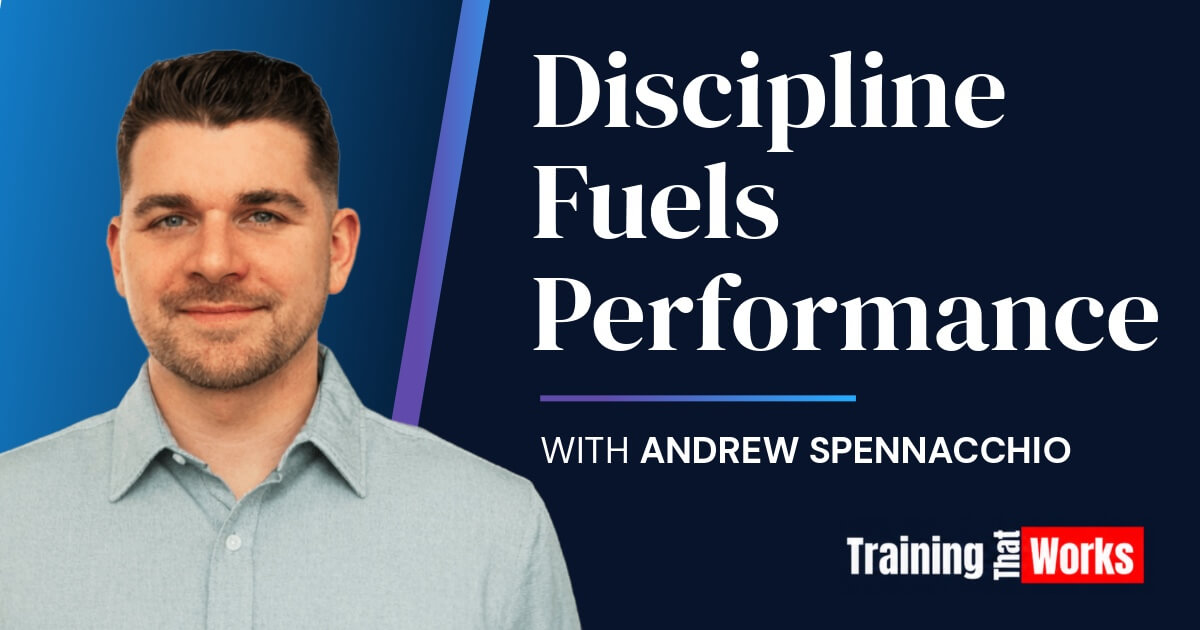
Rustin · 00:00All right, welcome to Training That Works. Today I'm joined by Andrew Spennacchio. Andrew has spent over a decade in sales across healthcare and tech, leading teams, training reps, and now driving revenue at a startup. He's passionate about coaching, mindset, and using creativity to keep training real. Andrew, it's good to have you here, sir.
Andrew · 00:19Rustin, great to be here and finally got this on the books. It only took like three, four weeks, so yeah.
Rustin · 00:24Yes, Yeah, for sure. know life gets crazy and certainly busy. So why don't you tell us a little bit about yourself and kind of how you introduce yourself if someone says, Hey, what do do for work that's kind of out of your industry?
Andrew · 00:39yeah, sure. That's fine. I'm just on myself. Like you said, I've been in the pharma tech space in commercial roles for the last 10 years. so selling data, selling analytics, and services. So right now I'm at, one of the more exciting shops I've been at in my career, integral. I won't plug them too much. you know, I think a lot of what we'll talk about here, kind of my own thoughts, but, we're an awesome company. We're in the. data infrastructure and privacy compliance space. So if you're out there looking at ways to link tokenized de-identified data, send me a message, right? Yeah.
Rustin · 01:17right. That's awesome. And that's such a huge industry right now. That's it's growing like crazy. So good industry to be in. So let's dive into the training side a little bit. Obviously you've taken a ton of trainings and you've been a part of training for a long time. What's the best training that you've ever taken and kind of what made it great?
Andrew · 01:39Great question. I would say the best training I ever took was my first sales job out of college. I was given mid interview, a stack of papers. It wasn't really a book, but I kind of had this in-person interview and they said, study that, read that, and then we'll kind of come in and talk about it for your final interview. And it was just spin selling, right? So it was situation, problem, implication, need payoff and understanding that and
Rustin · 02:02You
Andrew · 02:08That actually, Rustin, the reason why I think it was so impactful on me is because I really owned it. And it wasn't something that I was told maybe in a job, hey, we need to do this. It was more so I knew I needed to learn it. I didn't have a job. And the content that I found within it, I found it really translated well to cold calling, which, you know, still happens today. It was very big when I started selling in Manhattan.
Rustin · 02:14Mm-hmm.
Andrew · 02:38and just, you know, building rapport and kind of getting those green lights to continue that conversation. so yeah, I think it's really all, there are so many different sales trainings that you can take. It kind of goes back to me, saying of like, it's not what you say, but how you say it. think with training, there's so much out there. It's not necessarily what you consume, but what your mindset is and how you consume it.
Rustin · 03:04Mm-hmm. Right.
Andrew · 03:07you know, both as an individual and then like, certainly if you're working with a manager or teams and kind of how you go about sort of measuring the success of that all plays a part.
Rustin · 03:17Right, right. And I think you're exactly right. I mean, especially that first training that was so like, here, go learn this. I mean, that was kind of on you to really dive in, digest the information and use it. I love that the mindset piece because that plays such a huge role. Can you talk a little bit more about that and how mindset has worked for you and what you do and what you recommend for others?
Andrew · 03:40Yeah. And the other thing I'll just say about it too, is I suppose it helps if your back is against the wall. Like everyone's tried to get jobs out of college and I remember, you know, making a ridiculously low salary, needing to sell in order to earn and pay the bills and couch hopping for eight months. know, so yeah, I mean, I think awareness is, is really important, right? Like, you know, I played basketball growing up. I still play golf. and so there's kind of that, that idea, like just going out and playing pickup or going out and playing 18 holes, like you actually don't get better doing it. Maybe you do sort of, and you have a good experience and you have fun, but like, what are the specific skills that you feel you want to elevate? And those could, those could actually be things that you believe in. People tell you you're already really good at, but maybe you can get better. and so just having almost taking like, So right, anyone with a sales background, what's the customer problem? How can I match that to a solution? Almost treating ourselves like that sales opportunity, right? What are my problems here? And sometimes that requires a lot of reflection. You we could talk about meditation, who you can talk to, to, if it's not yourself, if you're uncomfortable having conversations with yourself, you know, to unpack that and figure out where to spend time. And then it's like just...
Rustin · 04:48Mm. You
Andrew · 05:07one day at a time for me. A lot of this could be overwhelming and we already live in an overwhelming society. you know, one day at a time.
Rustin · 05:16Right, right. I actually really love what you said there, treating yourself like, you know, the sales opportunity, like, you know, what are the problems? What are the solutions? How do I fix them? I love that. Just that that line alone, I think is awesome. So thanks for sharing that.
Andrew · 05:29Yeah. Yeah. I had a current example. I'm just kind of thinking now in my new role, again, I have a lot of experience in pharma tech and the clinical side of the house and certainly how real world data is, you know, is leveraged for feasibility and, and, and, and trial recruitment. My new role, I've sort of found myself in the last, let's say five months, kind of deep in the ad tech and marketing. healthcare marketing space. And so for me, in order to ask, right, in order to establish credibility, right, if you think about from all the way to the beginning, booking meetings, what's my messaging to on calls, how can I establish credibility? How can I introduce a little bit of uncomfortableness is the word I'll use, but like, I find that pretty useful in sales, like asking tough questions, doing that without knowing the nuances of the industry is incredibly. stressful, right? There's a lot of anxiety there and there should be. So it's like, what do I need to do? And, know, long story short, it's like taking a RFP we sent out, asking chat GPT three hours worth of, well, let's say five to 10 different prompts and spending three hours writing down everything until I was able to communicate this story, in a way that I can teach it. It sounds like a lot of work, but in four hours,
Rustin · 06:29Right. Right?
Andrew · 06:57I was so much more confident and then able to go out and kind of do those revenue generating activities at the level of which I'm like accustomed to. And that's just like on me, it goes back to awareness. Like I knew I needed to do that and I just took it one hour at a time. And there's still a lot of growth there that's required, but you know, that's how it is.
Rustin · 07:20Right, no, I love that. I love the awareness piece of it. Especially, like you said, you're studying the marketing, you're going deep on that. yeah, obviously credibility and authority is huge for that. Will they trust you? Do they trust you, that piece of it? But I love how you mentioned taking what you need to learn and then trying to teach it. For me, I've always found that is the absolute best way. I may know something, I may have heard it 30, 50 times, but unless I'm actually speaking in my own language and teaching it to someone else, even if it's to myself out loud, it's unbelievable how hard it is to take what you know and put it into words. And you don't really know it until you can teach it. So yeah, I love that piece of it a lot. So thanks for sharing.
Andrew · 07:59Yeah. Yeah, I think, I think you made a lot of, a lot of good, like kind of rifts on my points there. I think again, not to be like that guy, like, especially in today's day and age, but like we talk about distractions. It's so easy to say, okay, here's what I need to do and maybe do like a six out of 10 job at it. But you have what, like 30 of those in a given day and we all have lives and Some of us have kids and all these things we need, want to accomplish. So, finding a way to like put a bubble around what you're trying to accomplish and like commit to that and, know, feel, feel good about those small wins. you know, salespeople feel great about bringing deals in, but sometimes we need to feel really good about, doing the right thing by ourselves and whether, you know, and people can relate to this, right? Getting up in the morning in the winter and going to the gym.
Rustin · 08:35Right?
Andrew · 08:58I know you have, you want to do it and it's important at your goals, but a lot of the time you don't. right. It kind of brings me to another point, like the way that I, the way that I increase my probability of doing the things I need to do in my job or doing the things I need to do in my own personal life. Yeah. Right. So taking care of the things I know I need to take care of the physical health, the mental health, that all that stuff is really important. And then the rest becomes like, it's like doing
Rustin · 09:16Exactly.
Andrew · 09:29something one way is the way you want to do it. All the way. just made that up. I know there's a saying there. But yeah, it's like the way you do one thing is the way you do everything. That's what.
Rustin · 09:36Right. Yes, yep, yep, that's what it is. And I agree with that. And you are correct. mean, this day and age, are a million ways to get distracted, but not only distracted, there's like a hundred different rabbit holes you can go down on any one of those distractions. And because the information is just instant, it's like, if you need something, you can just keep going down that rabbit hole. yeah, hyper-focus I think is absolutely key. But I mean, it's just like, if you're not, here's what I'm working on one, two, and three today. I mean, I know it even today. mean, even before this podcast, I have things that I was supposed to do, but I was like, okay, I gotta do this, this and this. And it's like, if I get off of that, that hyper focus is so critical.
Andrew · 10:22Perfect example, I have a bone to pick with LinkedIn. They have reels now and I find myself watching them. I'm like, what am I doing? You know, so it's everywhere.
Rustin · 10:25no. Right. Yep. Exactly. it is. It is. So, hey, let's talk a little bit. What's the worst training that you've ever had and where do you think trainings go wrong?
Andrew · 10:42Yeah. I had an old, I think it was an old boss or an old colleague that made a comment that I was like a sales trainer's worst nightmare because I had the tendency behind the scenes to be like, you don't really know. So, so, and I think the reason why I may have said that or felt a certain way, obviously being kind of respectful and contributing everywhere that I can is when maybe sales training doesn't do the actual. sales training in the sales training, right? So you're training about asking good questions and knowing your customer and figuring out what the problems are. And you're going through a one hour PowerPoint to kick it off. Right. And so it's just the inherently obvious things. and I've had some awesome sales trainings, you know, at the end of the day too, it's about the individuals being bought in. I think it's on salespeople, sales leaders, and the culture.
Rustin · 11:14Mm.
Andrew · 11:41to really like understand the why. And if the audience is bought in, as you know, Rustin, that makes it so much easier for the coach who, you know, is expecting feedback. It's not a one-way street. It's not a Ted talk. Yeah, sure. You can go out for 20 minutes and kind of like an opening, you know, segment there, but it's really important to understand. do the, whatever sales you're training, kind of just go out and do it live.
Rustin · 11:47Yep.
Andrew · 12:11Um, which is something that I've done when I've kind of led some sales trainings within my teams in the past. um, yeah, it just, makes it more fun. It's, it's a natural, it makes it lot easier instead of kind of having to think about what to do. It's like, Oh, I do this, you know, five, six times a week with my prospects. Let's. You know, let's just go out and start having a conversation.
Rustin · 12:30Right, right, no, I agree wholeheartedly on the understanding the why. And if you don't know what's at stake and the reason you're doing it, it's really, makes, it makes, it's just so pointless sometimes. It's like, okay, you really need to focus on that. So I'm glad you said that. So Andrew, if you were in charge of, they said, all right, Andrew, you're in charge of all training at the company. We want you to run everything. What would that look like? What would your system look like?
Andrew · 12:55Well, the first thing I would probably acknowledge is that's not my skill necessarily. As I know I'm on this podcast as, you know, to talk about sales training that works, but, the way that you phrase that, you know, if it's a larger organization, you know, there are individuals that are, and I'm kind of answering that in a sense of like right now in my role, right. I'm a sales person. So I have plenty of things on my plate. being able to, even though I may have some good ideas, delegate that to. folks who are maybe in those positions, I think is really important. But let's just say for the sake of it, I think the question was like, can you repeat it? was, was kind of general. Like what would we do for sales training? Yeah.
Rustin · 13:33Yeah, yeah. no, and I understand your hesitation. I said, if you're running all training and let me back that up a little bit. Obviously, the L &D teams and all of the training teams, a lot of times they listen to these episodes and they take ideas from like, all right, this person would do this. Because if you're not in, sometimes when you're not in the thick of it, you have ideas that wouldn't normally come up because you're used to doing things a certain way. This is a question I like to ask of like, what is it if you were in charge of, they just said, Andrew, you're in charge of training moving forward. We don't care about your experiences. You're in charge of training. What would it look like?
Andrew · 14:09Okay, great. Thank you for that. So if I'm in charge of training and I'm responsible for the success of a training program, it's a great question. you know, I think one of the first things I would do is say, how do I, going back to my earlier points, how do I get folks to buy in? How do I get them to go all in on this for them and not for me or the organization? Right? Some people want to make more money. Some people want. public recognition, some people want just to feel that their contributions are valuable. So I would have one-on-one conversations in real life if possible, but certainly can do it on Zoom with the folks, with your customer, right? If your customer there is the seller, right? And your job is to kind of get them from A to B. It's like, first of all, where do they want to go? I'm actually listening to this book that was recommended by a colleague right now called unreasonable hospitality. It's about the GM of, or maybe the former GM, not sure if he's still there, 11 Madison park, which is like a Michelin star restaurant. And it just talks about all the, like, so there's like reasonable hospitality, things that you would expect and probably how a lot of us go about our day-to-day jobs. And then the unreasonable hospitality, Like I cannot believe that like blown away by sort of the customer experience. So it just kind of made me think of that. If that's my job and I reach out and have a one-on-one chat and show I really care and want to get somebody to, you know, their end goal. That's a huge difference versus signing into a zoom and, know, texting all the other salespeople like, I can't believe we have to do this. We all know those text chains go on.
Rustin · 15:54Right. No, and I absolutely. Yes. And I love what you said there. How do I get them to buy in and then talk with everybody, you know, one on one and find out what's most important to them? And the fact that you then mentioned the book on reasonable, which is an unreasonable hospitality, which is an amazing book. And I like just think of everybody in sales or anybody in who deals with people, basically anybody who works should have to read the book. I mean, just like it really puts a perspective on, unlike you said, something that's reasonable and then something that's unreasonable where they're like, okay, wow, I can't believe they did that. Cause that builds your own personal brand that builds who you are. People then start trusting you and think, wow, I wanna work with Andrew. I don't care where he goes or what he does. I wanna work with him because I was treated like this. So I mean, love that you said that. thank you for sharing.
Andrew · 16:46Yeah, sure. listen, I've been, I'm almost done with the book. I listen kind of when I walk my dog in the morning and it just helps kind of jog my brain a little bit. Like, oh wow, like that, how can I apply that to my role? Even though it is completely different and about the restaurant industry, that's some, that's where some of the best ideas I think, and creativity could come into play. So I think it's like not meant for maybe one audience and they take it and say, oh yeah.
Rustin · 17:01Right. Exactly, exactly. my actual next question was like, you have any books you recommend? Besides that one, are there any like business books that you really like or that have really changed how you think about things?
Andrew · 17:24yes. we didn't talk about this, so for the first time. There's a few, think, think one and really just kind of on a, a personal note, I will give you a, a book about mindset that helped me. And then I'll give you more of like a tactical one because I don't think this will be for everyone. The first one, the first one is an untethered soul by Michael Singer. And this book is for anyone that maybe meditates or is into kind of yoga or,
Rustin · 17:48Okay.
Andrew · 18:03I guess you could say it's definitely on the spiritual, mental side of things. Yeah, just kind of talks about how to take a macro perspective on things and not, I guess, everything that you hear going on in your own brain, like taking it with a grain of salt and realizing like, that's just you talking. You don't have to listen to it. So that might've been a bad way to explain it, but I would definitely check it out for anyone kind of curious about, know, anyone that's dealt with kind of like fear or, you know, about to take a big risk. tons of stress, like things of that nature. Again, going back to grounding ourselves in, in, you know, reality and really kind of knowing who we are and why we wake up every morning. I think that's a, it's a really powerful book. and then I don't have any other books I could think of off the, you know, top of my head. will say that for me, figuring out what I like and listening to it, or reading it multiple times is way better than trying to consume everything. there was this, it's like the diary of a CEO, it's a podcast and they had this guy, think his name was like Vin, and it was all about public speaking. And so it goes back to like my point before on like how you say it. And for me, and I'm not actually sure how good I am doing right now, he talks about how to deliver messaging. and speak in a way that captivates an audience. And I thought to myself, I've never really spent time on that. How can I, how can I be better? and so I've listened to that twice, right? And I've listened to some like Louis hose podcasts twice. And, there's just so much out there. think for me, I like to save whether I'm in like Spotify or Apple and just kind of save my own library.
Rustin · 19:38Mm. Right. you
Andrew · 20:05And then I can always go back after six months in a year and be like, wow, look at how much I learned versus right. The chaos of everything. And then you're like, I don't really know what I do or what I've learned. That part is anxiety inducing, right? For anyone trying to get, trying to get better.
Rustin · 20:12Right. Right, right. Right, right, for sure. I like that you said that. Do something multiple times instead of like hundreds of different options and sources. Just find one that's really good, learn that multiple times and really learn it. And I like what you said about the pub. Yeah.
Andrew · 20:32All right. Cause then if you read it 10 times, you could probably coach it. And we talked about that part. Right.
Rustin · 20:37Exactly, exactly. And I like how you mentioned the public speaking piece too. I think that's really important. I should get somebody on here. Maybe I'll find out who that was that was on that podcast and bring them on. Because that's such an aspect, such an important aspect to not only sales, but to training, teaching, to every aspect of life. You knowing that you're doing well and knowing that you're confident about that, I think is really good. So I'll look that up. Maybe you can send me the link afterwards. Yeah.
Andrew · 21:00I'll send it to you. You we talked about having your back against the wall and at times that's what brings out the best in people. I this particular guy, he had a stutter and he was bullied in school and he flipped that 180 and became one of the best speakers and a speaking coach. So it's like, you know, a lot of that is really powerful and kind of the, and you can kind of create your own origin story. I think you don't necessarily have to go through kind of a traumatic experience.
Rustin · 21:11Mmm. that's awesome. Sure, for sure, for sure. All right. So how, what would you say drives you personally? What drives you and why do you work as hard as you do?
Andrew · 21:37Yeah, so providing for my family, definitely up there on the list. In addition to that, I've been in this industry for 10 plus years now. There is so much potential. I can't even imagine where technology and AI and all this stuff is going to be in five, 10 years. So a lot of it is like keeping pace with what's happening out there in the world. A huge thing for me is the individuals who hired me and believed in me. I always have that in the back of my mind. It's like I made a commitment to them to do a certain job and do it really well. So it's really important to me and kind of my values that it's not only myself and the personal gains that I can get out of it, but there's other folks that are a part of this that are trying to do even bigger and better things. So being able to contribute. to something bigger than me means something.
Rustin · 22:41Right. So being in this obviously for over a decade, what's something that most people don't realize about your journey?
Andrew · 22:54I often have no idea what I'm which is a, I mean, you you sort of have to figure it out in, in life and in sale. think the most important thing is the awareness of, okay, there might be a little bit of an imbalance here. And I know in the past I've, you know, figured it out. And so what are the things that I've done?
Rustin · 23:00That's awesome. Yeah.
Andrew · 23:22Do I need to do anything differently this time? you know, try and remember that, you know, we're kind of all on this planet revolving around the sun, trying to figure it out together and, you know, treat everybody with respect and love and don't get caught up in all the stuff that goes on in the world. You know, there's a lot of chaos out there. So just appreciate every day.
Rustin · 23:47it. Right. Right. No, I love that. That's that's very real and totally understand. I mean, I get that. I remember when I when I started this podcast, it was absolutely terrifying. Like I was like, why? I thought I'd never be able to get through like, you know, 10 episodes just because it was like it was so much work just to ask questions because I was so nervous. It was like ridiculous. But, know, after a time of, you know, like you said, I didn't had no idea what I was doing, but I had to start. Otherwise, it would never, you know, I'd never improve.
Andrew · 24:15Right.
Rustin · 24:18So, and now, you we can have this conversation where we're going back and forth, you know, we're talking about mindset and building and all that. It's just, it's awesome. So I really appreciate you being on here. do you have any final advice that you want to offer to people, whether in mindset or things like that?
Andrew · 24:36I would just say, you know, it's, you know, just believe in yourself. You know, you're this, the audience and the folks that are listening to this are looking to improve. think you can or you think you can't, you're right. I'm sure someone said that on this podcast already. Reese, no. Okay. Yeah. Yeah. It's, and you know, genuinely, if you, if you could, with 100 % confidence, say that you believe in yourself and you know, most things you do, then like, great, keep on that. And if you're maybe at 70 to 80%, like just try and figure out why and then go, go for it. Go all in. Yeah.
Rustin · 24:50No, I don't think so. Actually, it's a great reminder because that's so true. Right, right. No, love that. It reminds me of when my dad took me to a Zig Ziglar conference back in the day. And we went and I remember one of the stories that he said is that he talked about these two twins and their father was an alcoholic. And they asked them in separate interviews, well, you know, are you an alcoholic? And they said, well, I have to be because I am because my dad was, you know. And the other twin said, actually, no, I'm not an alcoholic. I'm not a touch alcoholic because my dad was. So it's just the mindset of like, am because that's, or I'm not because of that. So it's just when you said that, hey, take responsibility, take that piece of like, it's your mindset. You could have it go either way, but make sure the mindset is so important on that. So I'm glad you shared that. Thank you.
Andrew · 25:53Mm-hmm. Yeah, of course.
Rustin · 26:02And then, hey, if somebody wants to reach out and say, hey, Andrew, and ask questions and like that, where's the best place to find you?
Andrew · 26:10Just shoot me a message on LinkedIn. Yeah.
Rustin · 26:12All right. All right. Sounds like a plan. Well, Andrew, I really appreciate you being here for the podcast for joining. I know we went back and forth for a while. Finally got you to come on. I am. It was a fantastic episode. And thank you very much. It really means a lot. So thank you. Yeah.
Andrew · 26:24Yeah, I had a lot of fun, Russ, and thanks for reaching out. And I guess my last bit of advice is if you're kind of struggling with your sales process and where you need to get better, pretend that you're going to be on this podcast for 20 minutes and figure out what you need to say. And you'll probably, you know, go pretty far in figuring out what you need. So yeah.
Rustin · 26:38You that's fantastic advice. Way to end it. So thank you, Andrew. Appreciate it, man.
Andrew · 26:48Take care, have a great day.

 Apple Podcasts
 Spotify
 Amazon Music
 RSS Feed