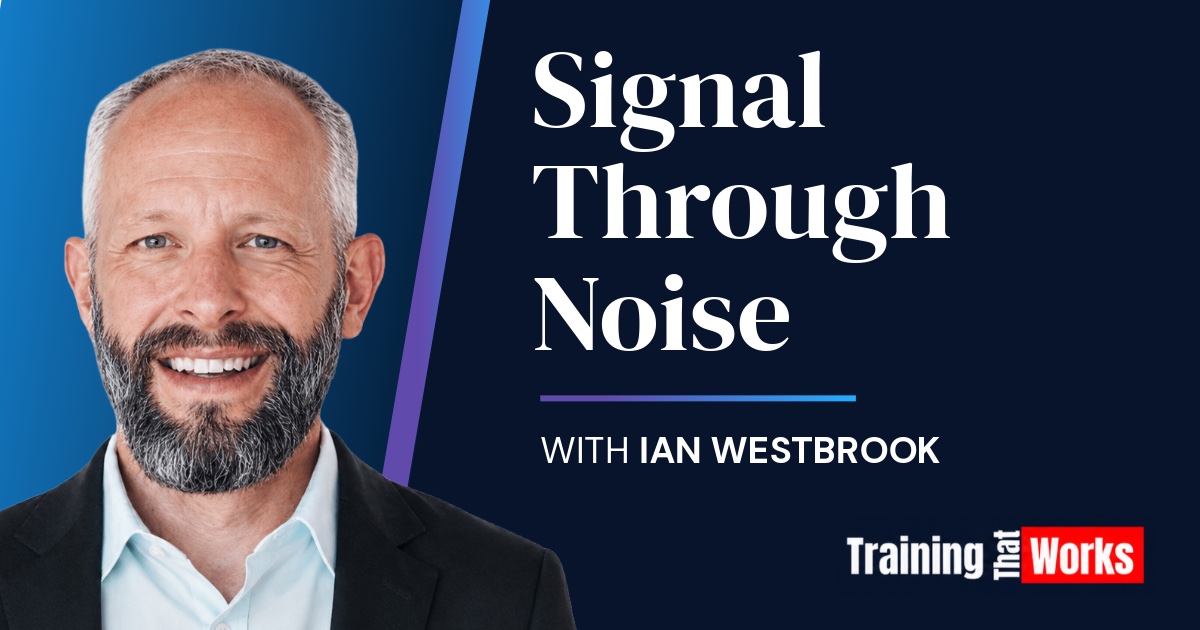
Rustin Schroeder · 00:00welcome back to Training That Works. Today we're going behind the scenes with one of the most dominant visual platforms on the planet. Our guest today is at an amazing company that helps hundreds of millions of people and the world's biggest enterprises create content. Joining us is Ian Westbrook, the head of Go to Market Enablement at Canva. We're diving into hyper growth, AI-driven creativity, and the playbook for scaling a global powerhouse. Ian, welcome to the show.
Ian Westbrook · 00:26Thanks for having me, Rustin. Excited to be here.
Rustin Schroeder · 00:28Yeah, yeah. It's great, great to have you. So hey, when someone outside the the tech world asks you, what do you do? how do you explain that?
Ian Westbrook · 00:36You know, the simplest way to talk about it is sales training, helping helping organizations ensure that their sellers are of the highest quality and that we show up in the best way. So yeah, in simple terms, it's training sales teams.
Rustin Schroeder · 00:50Yeah, yeah, fantastic. And can you give us a a quick background kind of on your career path and where you started and how you ended up here?
Ian Westbrook · 00:58Yeah, absolutely. So first half of my career, I was in the field. I was an enterprise seller for many, many years. I think anybody who's been carrying a bag for any amount of time, and in my case it was quite a long time, has felt both the ups and the downs. I I care to remember more of the ups than the downs. So had some successful years that were influential, but I probably learned more from those years that were more lean. in terms of what I take into what I do now. but yeah, that that's really where my start was was just a lot of years as a hunter and really having to get out there and turn over rocks and try and orchestrate larger deals at Fortune 500 companies. And that taught me a lot of ultimately what influences how I organize my teams and and how we train sales and field organizations today. So that that was probably the biggest influence for me for many years.
Rustin Schroeder · 01:56Okay. And then after you w were in the sales side, where did you where did you go to next?
Ian Westbrook · 02:00Yeah. So I was I was inspired, honestly, Rustin. I had a couple of I had a couple of great mentors. And on top of those great mentors, I should say that those mentors actually came from a space where they were enablement leaders who had inspired me while I was in the field. And I could see the power of having a one to many, one to many influence on an organization of individuals that were.
Rustin Schroeder · 02:04Really?
Ian Westbrook · 02:28Really great at that craft and how influential they were in shaping the culture and ultimately shaping the success of go-to-market teams. And so some of those individuals became my mentors. And it also came at a time when I I found intellectual curiosity around behavioral science, around data science. And those were things that I didn't feel were being satiated by my sales career. Although I enjoyed my sales career, I enjoyed carrying a bag. there are a lot of aspects that are exciting about that role. some of those elements just weren't being satiated. And so between those factors that I wanted to pursue and and some of the mentors that I had, there was a time in which I had an opportunity to to go through a door of building an enablement practice. at that time it was at the Oracle Marketing Cloud, and I walked through that door and and haven't looked back.
Rustin Schroeder · 03:24Right, right. So can you tell us w a little bit about that moment? So you've been in doing sales for ten plus years, you're really good at it, and then you decide, hey, you know what, th there's something else I would like to try here. I want to go to the enablement side and that I mean, that's a big jump. what was that moment like when you finally decided I'm gonna do this? I mean what I always like to hear that piece of it, like right before you decided, I'm not sure if I should make the move, and then yes, this is what definitely what I'm doing.
Ian Westbrook · 03:51Yeah. Maybe I'll I'll describe it I'll describe it in two ways. And that is, first I would I would describe a bit of hubris and humility. And I I've seen this pattern repeat, and that is those who are really effective in the field, whether they are in a frontline position or a frontline manager or a second line leadership position, there can be at times, and and and maybe I'll just speak for myself, some amount of hubris. Of believing that because you're executing on that game, that you know how to train and ultimately design and orchestrate at scale what's needed in order for larger groups of people to be able to do that same thing. And I I think the the the honest feeling that I had when I made the transition was I wasn't too far into that transition where there was a fair amount of humility that I found in that It is functionally a different practice. it requires a different skill set, it requires a different knowledge set than being out in the field. And you know, those things ultimately shaped the first couple of years after I had made that transition of of just really going back to basics and first principle thinking around what do I need here in order to be successful and and how can I drive the most impact in these businesses that I was in. you know, based on on what was ultimately a new craft for me mid career. and so I'd say that that there was a bit of hubris and a bit of humility. and both of those have served I would say in different at different points. But but yeah. Yes.
Rustin Schroeder · 05:29Right. Right, exactly. You kinda need you need both. And you know, you need the the hubris to at least dive into it and think you can do it. So you you know, you make the move, otherwise you would have stayed right where you were. that that's fantastic. And then the humility, like you said, finding out. So what as you were in it for a while, what is it that you decided or what is it that you really enjoyed about it and what did you you know, what became your path then down that the GDM GTM market?
Ian Westbrook · 05:40Yeah. That's exactly it. Yeah, you know, initially it was initially it was straight enablement, so focusing on onboarding and productivity. and then that evolved into developing, actually moving to an organization and establishing an effectiveness practice. So sales effectiveness. And maybe I'll add a third step that at that organization we determined that there was a real need For better go-to-market process strategy and design. And so I I built the first go-to-market process strategy and design organization at DocuSign and led that for several years. And so it was, it was really a journey that involved a lot of different practices, Rust. And it wasn't just pure sales enablement. It was sales enablement, but also a healthy dose of Of go-to-market strategy, go-to-market revenue operations, and then had a very unique opportunity with the Process Strategy and Design Org to start implementing practices of UX research, systems integration, and really good program management and data analytics. And so it it it expanded my view of what's possible and what's needed in order to actually get change to stick and how to do that at scale. and so it was a It was a journey that evolved from an initial enablement role, to then leading those practices in which there was a lot of different skill sets and a lot of different practices that were used very effectively. And a lot of talented people too.
Rustin Schroeder · 07:38Right. Right. I I I love that. I mean, you went from, you know, starting at the onboarding and the productivity side and the sales effectiveness, then to, you know, you're designing I think you what did you say? It was like process strategy and design. And I mean that's like the next step where you're learning. And then I love how you said you added in then UX research too and and data analytics and all of that. Then like when you have all this it What like what was the big did you have any aha moments where you're like, huh, now that I I kind of see the bigger picture of all these different things, what what did that did that create any like frameworks for you or or a new thought process at all?
Ian Westbrook · 08:18Yeah, it it definitely did. maybe I'll speak high level and then I'll actually reference a a framework that's been useful ever since. So h high level, and I I would my observation is that most that have been in enablement for some amount of time, and certainly those who are leading enablement practices, would agree that systems-based thinking and understanding the broader ecosystem is really important to that practice.
Rustin Schroeder · 08:26Yeah, would love that.
Ian Westbrook · 08:48Because enablement and training can only change and affect so much. It exists as a component within a larger system of incentives, within a within larger cultural constructs within organizations. And so with that systems thinking, you know, one of the one of the most effective frameworks that that I used and and implemented across my organization. when when I led the go to market process strategy and design org was diagnose, excuse me, yes, diagnose, design, instrument, measure, activate, and govern. And those buckets of being crystal clear, especially on large initiatives, understanding what, you know, what is it, what is the problem that we're trying to address in terms of the diagnostic and what are what does that ecosystem look like? that's influencing those behaviors. how are we gonna go about designing a program and instrumenting it, not just into a training, but also into our go-to-market systems, into our accountability structures? How are we gonna go about activating this, actually enabling and training on it when it gets launched? How are we gonna measure it? And how are we going to govern this this program so that we can create accountability structures that actually make it stick over time? And so that diagnose design instrument measure activate and govern framework was really effective in in shaping large scale change from go to market and from an enablement lens across scaled organizations or I should say scale field organizations. that one in particular had the most most staying power, I would say.
Rustin Schroeder · 10:35Right, right. And so y Canva then hires you for their go to market enablement. What was that and and their strategy? What what was it like moving from I mean, you're I mean DocuSign is a very large public company, but then you move to a very large private company, but with very high velocity. I mean, we're talking like I don't know if it's like two hundred and sixty million active users. I mean the numbers are crazy. what what was that like, that that change?
Ian Westbrook · 11:01You know, I think you know, it's interesting the there's simultaneous changes, some of which are Canvas specific, some of which are just the the time in which we exist right now. And that is number one is product velocity. And you know, the the product velocity and the release of new products and new features is something that is relatively new in terms of of what's possible. And so that requires a rethinking of how are you getting a large number of people to understand what the solutions are without over-indexing, because in the case of Canva, well, we're building an SLG or a sales like growth motion. And so that motion needs to be based on primarily on what are our customers' workflows and where are the challenges within our customers' workflows. Making sure that our sellers understand those workflows and they understand our customers' challenges. And then, of course, what are the solutions in which Canva can provide? And without over-indexing on purely talking about the solutions in which we provide, which is exciting to do, quite frankly. I find myself excited to talk about Canva and all of the different new features and new functionality and where we're going as a platform. but what's most important is that we're focused on our customers and our customers' challenges. And so I you know, I think the biggest difference is just that level of velocity and how much changes every month and every quarter and being able to keep pace with that and understand what is the signal through the noise that we need to make sure our field is actually getting and that's resonating with them and that is sticking. That is that is the biggest difference by far. And again, part of that is based on the company and part of that is also based on the time in which We exist and and what's happening on the A f A.
Rustin Schroeder · 13:01Yeah. And and how do you handle like the overwhelm? Like you said, I mean, product velocity is incredibly fast. I mean, you don't want to overindex, but how do you also not overwhelm and say like, well, here's these, you know, here's fifty new features? And how do you guys handle that?
Ian Westbrook · 13:15Yeah. you know, the the truest way that we have found, again, is to focus on the customer. And if if our conversations are focused on them and their challenges and how those challenges ladder up to their corporate strategies and how those challenges that that they're having are are laddering up to the bigger executive initiatives, if we're having those conversations. then that's ultimately really that that is the signal for us that can pierce through the noise because then we can we can turn around and say, okay, well what now now we can design a solution that's going to be most impactful to those organizations and drive impact. And so I think how we solve that is again focusing on what are we hearing from the customers and are we good at showing up as human beings in those conversations. And and I think in terms of enablement is, you know, are are we equipping our field with the skills that they can show up effectively as as good human beings, to conduct that type of discovery and have a good understanding of of the customers in conjunction with keeping pace on, okay, yeah, yeah, here's here are all the arrows in your quiver in order to solve some of those things once you've found them. So that's that's how we try and really create signal through the noise, that signal being, you know, the customer and their challenges and how those challenges ladder up to their their big initiatives.
Rustin Schroeder · 14:42Like that. And especially with like AI making everything easier for like product development, software development. You know, what's one what one tooks millions of and it used to take millions of dollars and then you'd have, you know, a product. But now they can do it, you know, pretty much for free or very low cost. And they're, you know, the moats of like, you can't build that, it are kind of gone and everything. The real differentiator comes down to like what you said. It like that. human philosophy. Can you talk a little bit more about that? Because I think that's a huge go to market strategy that that I think is just vital because that anybody can build stuff now and it's getting cheaper and cheaper and faster and faster. But it's like that that human piece is still what what what what's gonna win.
Ian Westbrook · 15:15Yeah. Yeah. Yeah, it it's a big shift. It's a big shift too in in what you were mentioning here, Rustin, of the barrier to entry for most organizations to be able to buy is very low. Right. And so, in order to and and we've seen this progressing over many years from an industry perspective, in terms of, you know, there's more power in the buyer's hands in terms of their ability to research solutions, their ability to understand and and be able to network and understand what. what solutions have the best support, whatever that might be, that that pushes the engagement with a seller later and later and later in the buying cycle. And again, we've seen that for five, 10 plus years that that that's been the case. And that has accelerated even more here in the last couple of years. And what that has highlighted is that you know when you live in a world in which organizations don't have or I should say that the product velocity is very high and the landscape is changing in terms of of you know who can do what that you really have to differentiate yourself in terms of how you're selling and how you're understanding your customer. if it's purely just based on a product feature comparison, that's not a good place to be in because that can shift. That could shift fairly quickly. Whereas
Rustin Schroeder · 16:47Very quickly.
Ian Westbrook · 16:49If if there are relationships and if there's a deep understanding of what the challenges are at an organization, if there are deep understandings as to, you know, what are the workflows that are broken, and and and by fixing those, how that ladders up into bigger impact for a company, those are the types of things that ultimately create the differentiation between winning and losing. And and that's still very much human-driven type of scenario, especially especially with Fortune 500 and and large scale. Enterprise and strategic sales motions.
Rustin Schroeder · 17:21Right, for sure. And and definitely having that understanding of exactly what your customers, like you said, the workflow, knowing exactly what they're doing, so you can jump in and say, hey, this, we could actually improve this, and prove, you know, improve what you're working on. So yeah, that's great. And and as the head of you know, go to market enablement at Canva, you probably have people pitching you every day. I mean, maybe all day long. You know, you get to see everything in the market, which is, you know, kind of a a good thing and a very t hard thing to manage too. It's but you get to see everything being developed. Has there been anything recently that stood out or surprised you that was incredibly useful?
Ian Westbrook · 17:58You know, I think that the biggest shift over the course of the last couple of years has been the ability to have really two things. Number one is conversation intelligence, being able to to see, understand, what are all the conversations, how are people actually showing up to those human-to-human engagements and what's being said and how is that being reacted to and and having that type of information at your fingertips and being able to identify those patterns effectively. is really, really key to making the changes that are necessary from a training and enablement perspective. and then the the other side of that equation is the ability to role play with, you know, AI role play and other mechanisms to to create safe practice environments for individuals to actually hone their craft and then again show up better when they get into that human to human interaction. Those two things are a dramatic shift from where we were let's call it five, six years ago. And some of those things were in very early development five, six years ago. but we're now at a stage where those types of technologies, things like gong and others, are you know really key and foundational to how you can actually not only understand what's happening and identify what you need to change. But then of course actually supporting that change and fostering that change in the business. So I I'd say that those are probably the the the two biggest things that have transpired over the course of the last several years.
Rustin Schroeder · 19:34Yeah, for sure. Yeah. And that conversation intelligence and the role playing. I mean, those are always have been huge to understand that. you you had mentioned gong. When you so are you if you guys are using Gong, what what did that journey look like for you? What was the decision process? Like how do we how did you decide, all right, here's the problem we have and and kind of what give it paint that picture for us of kind of where they came in and you know, how did they first earn your attention and that type of thing?
Ian Westbrook · 20:01Yeah, you know, some of that predates me, Rustin. So what what I can say is that you know, we we pride ourselves in staying at the forefront of what we're doing from an AI perspective and what we're doing from a go to market just well tech stack, but but just a go to market engagement perspective. And so I think w one of the main things is identifying
Rustin Schroeder · 20:04Okay.
Ian Westbrook · 20:28What's best in class? And do are we laser focused on the change that we want to drive and what are the best tools that will allow us to to drive that change? And with that philosophy, we've we've found a lot of success. we find natural adoption because we're we're solving our own workflow challenges. and so we find a lot of natural adoption. And then when we layer on top of that, effective training and accountability as to how people are using those and and the impact that we're getting from that that that creates a more I'd say seamless road for us, or less frictionless road in getting adoption internally.
Rustin Schroeder · 21:08Right. So can you talk a little bit about that internal? I mean, th this is the the training that works podcasts. How do you roll it out to your teams, like the the big changes that you make and what is that what does that implementation look like for for Canva?
Ian Westbrook · 21:21Yeah. I there's a couple of things and and part of this is best practice in general. And that is do we have buy-in and do we have accountability structures? And those two things are the primary, and when I say primary, with a capital P, the primary predictors of whether or not that change is ultimately going to have staying power.
Rustin Schroeder · 21:34Mm.
Ian Westbrook · 21:49And it's ultimately gonna have impact. Now, there are different ways in which you can approach getting that alignment, getting that buy-in, and there's different ways that you can approach the accountability structures. But at the end of the day, those two things are primary. And where we look to supplement that is with world class training and and world class, I'm gonna say tools, but really they are Things like job aids, things like coaching aids, things like what is the entire you know, training and and content stack that's going to support that particular change. But what I'd come back to, Rustin, is honestly it's it really comes back to alignment. and do we have the buy-in and are the accountability structures there? And then we build world class training to support that. if we've got those pieces, then we know where we're gonna be from an adoption standpoint and success standpoint. And when we're missing some of those pieces, we also know where we're gonna be, which is usually not not in the place we want.
Rustin Schroeder · 22:49Yeah. Right. No, I like thank you for breaking that down. That's actually very simple. The alignment, the buy in and the accountability, each of those play such a a a key role. So thank you for sharing that. on the more personal side of the the podcast, can you tell us like what's the best training you've ever had in your career?
Ian Westbrook · 23:09Best training I've ever had. you know, there's been several instances where I've been a part of of really high quality training. I I will reference a time in which I was at an organization, I was an enterprise seller, and there was alignment and there was buy-in and there were accountability structures, and the world-class training that was put in place. in that particular instance, we were trained on five key value drivers. And to this day, it's been many, many years, I still remember those five key value drivers. And I remember walking out of that training and the very next day attempting a conversation with one of my prospects in in in addressing what I had been trained on the day before in terms of those value drivers and hearing it resonate. and getting traction immediately. And I think that that had a very big impact on just again creating a lot of signal through the noise. And and you know, it's it's there's an adage of I I believe it's attributed to Mark Twain that's I I sat down to write you a short letter, but I didn't have enough time. So I wrote you a long one. And and so you know I think that that when you are witness to something that is very simple.
Rustin Schroeder · 24:26Exactly. Yes.
Ian Westbrook · 24:35And that is very curated. the observation, especially in trying to design those kinds of things, is that that's something that probably took a lot of time and a lot of thought to make it simple. And the best trainings I've ever been a part of are trainings in which there is a level of simplicity, and that simplicity has just come through a lot of really hard work and deep thinking around how to create that simplicity and how to create that signal. And so those have been the best trainings I've ever been a part of.
Rustin Schroeder · 25:04I love that piece of it and I couldn't agree more on the simplicity part. Sometimes that simplicity part is so unbelievably hard you know, to figure out how to get there, how to break it down to the absolute core of what you're trying to to to learn. And it it it's it's so much work. And then when you finally get it, it's like, wow. It's it's amazing. did you have a a terrible training experience you could share?
Ian Westbrook · 25:23Yes. Yeah. I've I've I was in sales for long enough that I've got a lot of terrible training experiences. and I also have enough humility to recognize that I've I probably unfortunately have been the the arbiter of trainings that have not landed as well as I intended or or my team intended. and those are learning experiences for everybody involved. I think, you know, there's one thing I talk about, Rustin, to to a lot of teams is that
Rustin Schroeder · 25:31Ha ha.
Ian Westbrook · 25:58I've been on both sides of this equation and been on both sides for some amount of time. And that there is a a very strong tendency, it's it's almost like a tide that pulls you out to the ocean, of training becoming an abstraction to the to the job that it's actually training. And that if it's not addressed and very consciously, you're if if you're not very consciously swimming against that tide. It will automatically happen. That training will just become an abstraction. And if you are the person who is being trained, if you're sitting in that room and you're thinking to yourself, this has nothing to do with my job. This has nothing to do with with what I need to do later this afternoon, tomorrow, next week. Why am I here? you know, it what I would for the the folks that are thinking that, which I've been in that situation many times, and that's a very valid thought, is that for those that are training you.
Rustin Schroeder · 26:40Mm.
Ian Westbrook · 26:54It is very easy to for that abstraction to take place. And so you for those of us in the practice of training other individuals and trying to create change, we have to swim against that tide and be very conscious about is this training actually applicable to the job that for the people that we're actually training? And so I'd say that the worst trainings I've been a part of are that abstraction, they're just for one reason or another, that training organization or those trainers weren't able to swim.
Rustin Schroeder · 27:09Mm.
Ian Westbrook · 27:24Hard enough or fast enough against that tide. But yeah.
Rustin Schroeder · 27:25Right. Yeah, that's a fantastic answer. And I think it it comes down to I think one of your sentences in there saying, Why am I here? If at any point they're wondering why why am I even in this training, there is something fundamentally wrong. And I just that was that's a perfect summary for the question. So thank you, Ian. what's a a business book, a training, or maybe a learning experience that kind of really changed how you think or like really impressed you and was like, wow, this is this is an important work.
Ian Westbrook · 27:56Yeah, there but there's a lot of them, honestly, Rustin. There's some really great work out there. I'm gonna mention three. The the first I'll mention is Revenue Architecture by Jacco van der Kooij. I think that that Jocko's work is very it it it pushes the envelope in terms of understanding go to market and understanding some of the different factors that ultimately influence the success.
Rustin Schroeder · 28:04Okay, fantastic.
Ian Westbrook · 28:25of go-to-market organizations. So that one's been very influential. another one that stretches back some amount of time is the book sales enablement by Tamara Schenk. it lays out a very clear structure associated with enablement and the services that enablement can provide organizations and and how to be thinking about some of those services which I I I believe is still relevant today. And then a third that I would reference is Robert Brinkerhoff. And Robert Brinkerhoff and his development of high performance learning journeys and that on the job application, that learning and skill transfer is best served when it is on the job, w when we are doing the thing. That's how you learn is when you're doing the thing. It's not in a classroom. where that real skill transfer and knowledge transfer is happening. It's when you're doing the thing. And so I'd say a combination of those three are are at at the absolute pinnacle of of what I keep going back to and and flip through on a very regular basis, because they're just really foundational and fundamentally great works in my opinion.
Rustin Schroeder · 29:39Yeah, that's fantastic. Thank you. Thank you very much for sharing those. in a in a world where AI can say like write your email for you, what makes the communication actually feel trustworthy?
Ian Westbrook · 29:54You know, I I would say that there has to be a human element to the language in which you're reading. And when I say human element, I I feel as if we can oftentimes depict, you know, is this something that's that's canned? or is this something in which I even even predating AI, Rustin, I think we we you know, there were systems that would would allow sort of that manufactured type of communication versus versus a communication that feels more human. And again, I'll go back to one of my earlier points that we've been talking about. Does that communication, is it try, you know, has there been an effort to understand what are the challenges I have, what are the workflow friction points that I have in my business? Wha how does that ladder up to the things that are keeping me up at night or or at least keeping my organization up at night, so to speak. And I think it's those types of communications that are human and that have taken an effort to actually understand where I have friction, those are the ones that resonate the most in in the age of AI.
Rustin Schroeder · 31:02Do they understand? I mean, because you can you can have an email sound perfect, but if they don't really understand you, you it comes across that way for sure. and you can tell. You can it it's it's a an instinct that you can really just tell. what's one thing about your journey, Ian, that most people don't realize?
Ian Westbrook · 31:23I think one element of my personal jour journey that most people don't realize is that I had two opportunities, one of which was influential in how I view go to market and and enablement. And that was I had made a decision at one point in time where I was gonna go down a path of becoming a data scientist. this is earlier in my journey. And while I decided not to pursue that path from a professional standpoint, it was really valuable to reacquaint myself, at least at that juncture, to the foundational elements of statistics, which I hadn't revisited in my professional career in a way that I had when when I was going through my education. and so that actually became foundational to how I was doing things in the the path that I stayed on. And so whilst I almost took a left turn and and went down a different path, it it added a lot of value to the path that I'm on today. And and still even even today it I revisit those principles on a regular basis because they they're impactful in how how we understand what we're doing and how we understand where we're tacking towards.
Rustin Schroeder · 32:46Sure. Yeah, that that data science piece is really important and and often overlooked. and especially with someone who's on the enablement side. I mean, they're usually two different functions. And then when you can kind of understand both, I think that gives a a huge advantage for sure. so hey, for leaders who are like they're fighting tool fatigue, they're trying different things to scale their teams, if there's one piece of advice you could offer to someone listening, what what would that be?
Ian Westbrook · 33:18Process first.
Rustin Schroeder · 33:19
Ian Westbrook · 33:21And I say process first because, you know, I think we we're all looking to make the best decisions for our organizations, for our teams, and to some extent for ourselves. and sometimes those decisions feel as if they're they're black and white in terms of I can I can get this tool and it's gonna solve this this thing. And, you know, it it it feels good to do that and maybe we can show impact from that. My experience has been that that those are usually short horizons of impact and that the times in which we understand our process and what's broken in our process and how tools can help with a very laser focused help with those workflows and help particular elements of that process, that we typically have a much longer horizon of impact and those types of tools. And so I think you know, now in this age of AI where tools are being built, to some extent you can build certain tools yourself internally with the use of of AI, that there's a risk of just again another proliferation of even more tools and and more ways to do things that coming back to process, understanding your workflow and where the friction is in the workflow, that if you're focused there and trying to understand is is this tool providing me you know, a a solution within this workflow, then that's the best place to be.
Rustin Schroeder · 34:56No, I I like that. Thank you for sharing that process first and then where's the friction? Cause that that is gonna always be, you know, the key. Where's the friction? 'Cause if that continues, it things are gonna go sideways. And they always do. That friction is just it, you know, that needs to be solved. So hey, thank you for sharing that. That that that's great. So Canva's doing some in you know incredible things in the market. you're aggressively pushing, you know, into the enterprise and AI market. where can people, if our listeners wanted to follow you and your personal leadership journey, where can teams go to see what you're building and what Canva's building next?
Ian Westbrook · 35:31Yeah, absolutely. of course Canva dot com and for me personally, LinkedIn, Ian Westbrook and you'll find me. And that's probably the best place to to watch and see the journey. So
Rustin Schroeder · 35:47Sounds good. And I will definitely link to your profile on the Training Networks website. So Ian, thank you very much for coming and doing the show today. This was a fantastic and I just there's so many. I think I took five pages of notes here. So I just this is exciting. I can't wait to get this one published. So thank you for joining.
Ian Westbrook · 36:04Yeah, absolutely. Well, thank you, Rustin. I appreciate you having me and yeah, I look forward to seeing the finished product.

 Apple Podcasts
 Spotify
 Amazon Music
 RSS Feed