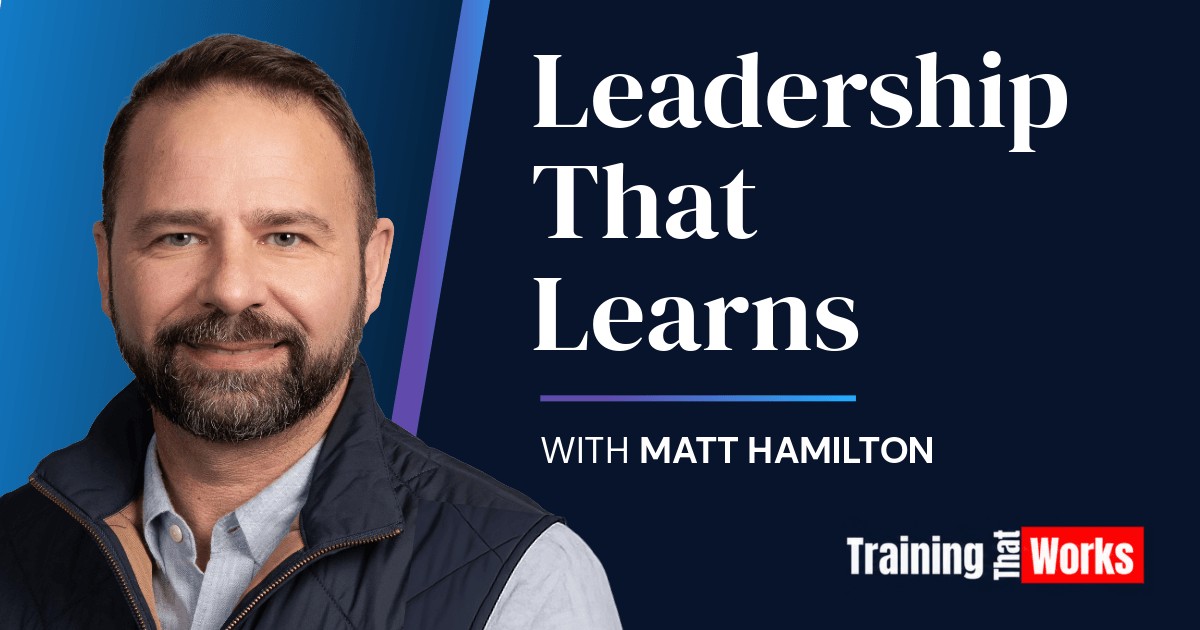
Rustin Schroeder · 00:00Welcome to the Training That Works podcast. Today's guest is Matt Hamilton, where he is the Senior Director of Sales Engineering for Casepoint. He has spent his 30-year career in the legal and technology fields, holding various roles from team member to leadership positions. His area of expertise is working with sales teams to assist and lead them to success. Welcome, Matt. Good to have you here.
Matt Hamilton · 00:23Good morning.
Rustin Schroeder · 00:25So, 30-plus year career, at the intersection of law and tech and sales. How do you explain what you do to someone who doesn't know?
Matt Hamilton · 00:37Well, that's a good question. And I get this. My kids would be, they're grown adult kids. My son gets it, he works in the same industry, but my daughter still is trying to wrap her head around it. As a sales engineer, my main focus, my daily task is, how do I help the sales team become more successful? Now part of that is I demonstrate. We're a software company, so I have to do our demonstrations, but I want to be an asset to that conversation. I don't want to be just, hey, let me show you the bells and whistles and we move on. I want to help progress that along. And that incorporates some training aspects to make sure that the salespeople know how to talk about things the right way, keeping abreast of what's going on in our space.
Matt Hamilton · 00:52So really I'm a tour guide. That's what I call myself. We'll stop at the sites you want to see. And if you go, done with this, we'll move along and go to the next one. So that's kind of how I position it.
Rustin Schroeder · 01:32That's a fantastic way to put it. I love that. A tour guide. That's perfect. That is a great title. So as we go into that, let's get into training a little bit. What are some of the best trainings that you've ever experienced and what made it great?
Matt Hamilton · 01:53Wow. The best trainings I've had have been in more recent times. Obviously over a 30-year career training evolved considerably, from sit in a room for 8 to 12 hours and look at a whiteboard while somebody's writing on it, or even an old projector, to now online interactive training. The best ones have been focused with a blend between human interaction and technology, so you're supplementing the talk with the track, whatever it may be. Instead of a lecture, it's a conversation. Let me talk you through this. Let me give you a use case. And let's tie it into your role, your challenge, your industry, whatever the case may be.
Matt Hamilton · 02:18The most recent one was just last month. We had to do some security training, which everybody has to do now, with phishing and spam and scams and all that. It was the best one I've ever seen for that particular dry topic. They did real world scenarios. They didn't talk down to anybody. It blended some visualizations that made sense to show you the prolific nature of how phishing is working, but with some real good human interaction in it that was talking about this is what you need to watch for. A 45 minute session on phishing and identity theft was really, really riveting, unfortunately.
Rustin Schroeder · 03:28Yeah, that shows that it's definitely good training, because I myself have taken that same training, not that one, but I've taken the security and the phishing training probably 15 times, and they're always incredibly boring, incredibly dry. You're reading so much you're ready to hit the next button. But that sounds like fantastic training. You'll have to give me the name afterwards.
Matt Hamilton · 03:47It's almost where they're intentionally trying to get you to zone out. But this one was really, it was kind of funny. I remarked to my colleagues, I think that one was really good, and they were like, yeah, I dreaded going into it but that was really good coming out.
Rustin Schroeder · 04:16Very cool. You'll have to give me the name of that company afterwards. Maybe I'll put it in the show notes, but I would love to check it out myself. So on the flip side, what's the worst training you've experienced?
Matt Hamilton · 04:45Oh, I can't even remember it exactly. It was a two, two and a half day training in a classroom where you did four hour sections, lunch, four hour sections, whiteboard. And it was that artificial enthusiasm throughout, where they're trying to force you into, everybody stand up and let's go through this little chant or exercise. It was so fake and so manufactured. There was not a personal aspect to it. It felt like, oh, you're in another room, I have to do this again, instead of let me connect with even one or two people in the group. And you're in a room with 30 to a hundred people doing this for roughly 20 something hours. I would have gone to the dentist instead.
Rustin Schroeder · 05:23That's brutal. That's a terrible training. I like how you phrased it, artificial enthusiasm. It's so fake and everybody dreads it.
Matt Hamilton · 05:49It's so corny. The first thing in the morning he'd make everybody stand up and you'd move your arms to say, if I act enthusiastic I'll become enthusiastic, and we had to do it like five times. And you could hear the drone in people's voice. It didn't even come close to working.
Rustin Schroeder · 06:01That's miserable. Let's not do that again. So what's working in training today? You do a lot with the sales teams, you do a lot with training. What do you see that's working?
Matt Hamilton · 06:11The blend between human interaction and some type of technology, whether that's videos explaining the situation, because sometimes training is a heavy topic. Software training can be kind of dry. Sales training can be a blend where if you're using charts and demographics and data, used properly to hit the point, it makes a lot of sense. But the trainings I've seen that work the best are where somebody's giving you their war stories, but not for the sake of the war story. It's like, here, let me teach you something so you don't skin your knee the same way I did. And if you do skin your knee, that's fine, just don't do it in the same place twice. Learn through your mistakes.
Matt Hamilton · 07:34Being a person that's having the human interaction matters. If you set somebody in front of a computer for four hours and say, go learn this, they're going to walk away with almost nothing. Even if it's the most dynamic, you've got Matthew McConaughey doing the whole thing, you're going to forget the content. You're going to zone out. So it's got to be engaging that way. Having the human aspect to it makes a lot of difference.
Rustin Schroeder · 07:44I love how you said teach them how to avoid skinning their knee. That's a really great way to put it. So if you were in charge of everything and they said, all right, Matt, I need you to run all training moving forward at Casepoint, what would you implement and how would you do it?
Matt Hamilton · 08:03I've got the scabs and scars to prove it. That's a great question. Well, one, balancing the two, getting the engagement, making sure it's relevant topics, of course.
Matt Hamilton · 08:32Honestly, I think the executives need to go through the same training. Regardless of what the role is, if you're the chief financial officer and we're going to do new training for the sales team, you need to go through it too. If we're doing customer success training, even if it's on a software the CEO needs to go through it, at least the cursory intro 101. For a few reasons. One, it shows leadership is invested. Two, they're aware of what's going on. Three, they can make a decision, they're seeing where our money is being invested.
Matt Hamilton · 08:59And it proves to your team that you're not above it. You're leading by example. If they're never going to log into the software, who cares? They at least showed up for a couple hours to say, what you do is important for the company. I want to know a little bit about what you do. And it lets them let their hair down. I've been in instances where the C level is going, this may be a stupid question, and they ask the stupid question, and the sales team kind of giggles, but they get it, because they've asked that same question or they're still thinking it and too embarrassed to be transparent.
Matt Hamilton · 09:57Leadership involvement is critical. The mechanics, that's based on your culture too. What training works for one organization is not going to work for another.
Rustin Schroeder · 09:59Right, and I totally agree with it. I think that's a great point, because it really encourages the people to work, because they're seeing their leadership. Hey, you're doing what you're saying. You're not just telling us, go do this. You're saying, I'm in here with you, I'll do this. And that just makes everybody want to work harder.
Matt Hamilton · 10:17Well, in our organization, we just went through a merger. The legacy company I was with was a much older employment base. We were on average north of 40. We merged with a company who on average is around 30. So the way we learn is two totally different ways. You've got basically Gen X and then Gen Z and millennials, and we just learn differently. So we're trying to balance that training where it's tech plus human plus funny stories plus hands-on plus a certain level of maturity, but also trying to elevate everybody to the same place. You just have to be mindful of that as you're doing it.
Rustin Schroeder · 10:52That's great. Thank you. What are some of your favorite or maybe your top business books, or a book that's really influenced you in the business world?
Matt Hamilton · 11:17Wow. I read a lot around the psychology of people, behavioral type stuff. Being around sales and training and demos, you want to learn how people tick, what's going to resonate with them. Storytelling books, I do a lot on that. The most recent one is, we just went through a sales training on a book called The Jolt Effect for sales. It was really insightful, because it was talking about how people are afraid to make decisions but afraid not to make decisions, and how to balance that and use it. I also like Simon Sinek's, like the Know Your Why. His insights are around a lot of that psychology behind motivations.
Matt Hamilton · 12:11If you understand behavioral science a little bit, no matter what role you're in, customer success or sales or finance, you just need to know what motivates people, because it makes you more effective. I'm really geeky. I just read a 97 page article that Google put out about what's called the messy middle. It was really about marketing. There used to be a straight pathway between I need to buy something and purchasing it. The model they show is like spaghetti in the middle, because we're over-inundated with options, and the whole thing was around the behavior of how people make decisions.
Matt Hamilton · 13:08There's a huge application in the business to business world, because the consumers who buy their shampoo or their car or their insurance are the same consumers buying for business, they're just doing it with somebody else's money. It's freely available on Google. It was their perspective of marketing primarily.
Matt Hamilton · 13:36The one I use the most, honestly, coming from my faith background, is I rely mostly on scripture and the Bible. There's a whole idea there that leads me around, I don't work for a person, I work from my faith perspective. So that's my biggest business book, honestly. Treat people fair, treat them honestly, love everybody, and work as though you're working for a higher power, not for the person paying your check.
Rustin Schroeder · 14:05Exactly, for sure. And that kind of leads to the next question, and maybe answers a piece of it. What drives you and why do you work as hard as you do?
Matt Hamilton · 14:15That's number one. As a man of Christian faith, I don't work for a man, I work for God. So that's my primary motivation every day. I'm not doing the best because John Smith writes my check or hired me. I'm very thankful for whoever is writing my check and hired me, but I'm doing it because that's my calling. I'm supposed to work as though I'm trying to honor him.
Matt Hamilton · 14:41And I like it. I don't want to work somewhere I don't like, that's painful and not very much fun. The motivations change. I've had two kids growing up and going to college, and you work hard for that. You want to make your spouse and your family happy. So you work hard for those things too.
Rustin Schroeder · 15:09So that's a fantastic motivation. How do you motivate people to always have really good customer service when they come from all different backgrounds? Because to me that's the most difficult piece. Some people just don't care. How would you go about motivating someone who doesn't have that same, I want to serve other people, mindset?
Matt Hamilton · 15:50That goes hand in hand, and it's tough. You're honestly right, that is a ridiculously hard thing, to motivate somebody to be motivated.
Matt Hamilton · 16:00I look at it as leadership, it's servant leadership. If I'm not above doing whatever it is I'm asking you to do, then you'll follow in my footsteps without me having to tell you. That is my hope and my motivation. Like when I'm training the sales team on our CRM, hey, we're going to use this new tool. I'm going to do a few things. One, I'm going to go through the same training they have to go through even though I'm not going to use it, so I can talk to them about it and go, this is why it's interesting, why it's important. With customer success, your personal reputation is represented every time you get on the phone or send an email. You may not care about it, but you're part of a bigger team, and that reflects on me, even though I may never talk to that customer. You also represent me.
Matt Hamilton · 16:56So keep that in mind. It shouldn't put you on eggshells, but it should motivate you. I want to make everybody look good. Even if you don't want to yourself, I don't want anybody else to take what I think is meaningless. It means something to somebody. So I might as well do it with enthusiasm.
Rustin Schroeder · 17:01That's a great point. Thank you. Any final thoughts here before we close, and after those final thoughts, where can people find you? Let's start with any final thoughts.
Matt Hamilton · 17:33I am a lifelong learner. That's the biggest thing. I'm not married to any single business strategy or philosophy or thought, aside from my faith basis. There are really good things that come across books and YouTube videos and what have you. There are more resources and thoughts than any time in history. Some are great, some are horrible. Weed through, take the nuggets of good and the nuggets of bad. I don't tie my rope to one person. I may for a period to get what I can out of them, then move on to the next, and the commonalities and the cream bubble up to the top.
Matt Hamilton · 18:22Always, if you're in a job and you don't like it or it feels like toiling, go become better at it. Then it becomes less of a stress, and it prepares you to go to the next place. If I'm a trainer and I don't like training, go get to be the best at it. It makes you feel better, you're looked at as more of an expert, and when you go to the next place you have new insights and perspectives. If things are a chore or uncomfortable, making them better just makes them less of a chore. You can't change your boss directly, but you can change your boss through your perspective and attitude and the way you respond. There's an old Robin Williams quote, the meaner a person is, the nicer you should treat them. If you treat people well, they usually respond pretty well in the same facet.
Matt Hamilton · 19:21If you want to reach me, I'm on LinkedIn, of course. Always welcome to connect with anybody. It's Matt Hamilton. You can find me at Casepoint. I'm a sales director in the Dallas area, so you can figure out which Matt Hamilton it is, there are a few of us out there in the LinkedIn sphere.
Rustin Schroeder · 19:56Fantastic. Well, thank you, Matt. This was packed with great insights, so I really appreciate you being here. I have a feeling this is going to be one of our top download episodes. Thank you very much, and thanks for joining.

 Apple Podcasts
 Spotify
 Amazon Music
 RSS Feed