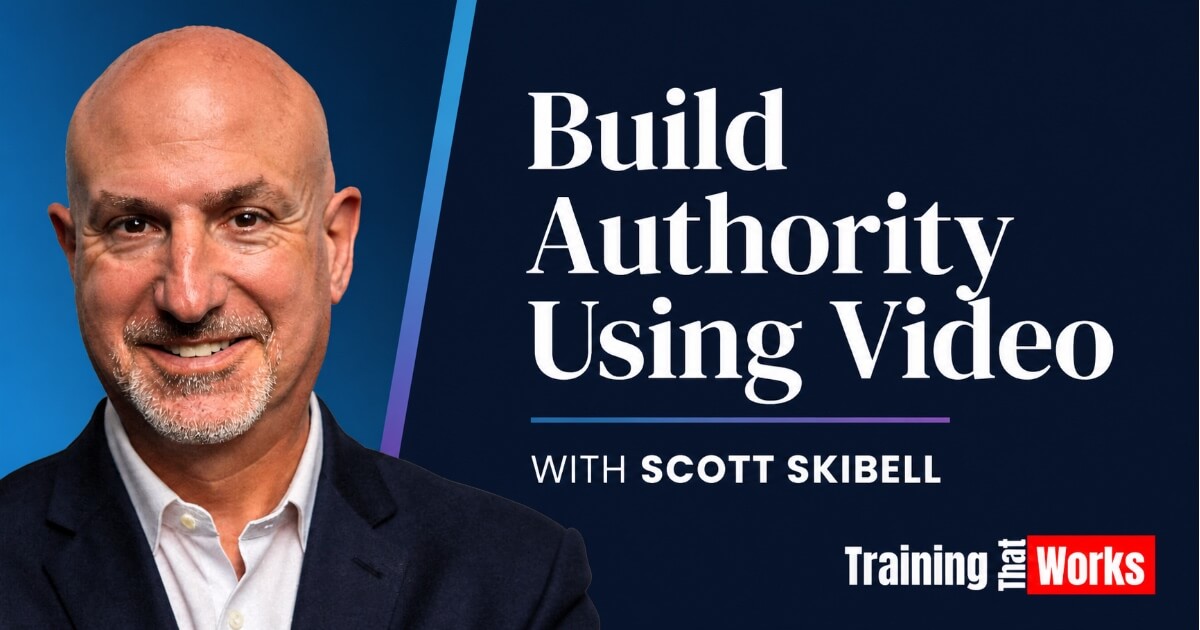
Rustin · 00:00Most deals don't die in the meeting. They die in how you communicate after. Today's guest, Scott Skibell, spent years training sales teams at LinkedIn. And now he helps professionals stand out instantly through video. Scott, welcome to Training That Works. It's great to have you here.
Scott · 00:16Rustin, it's so much fun to be here. I can't wait.
Rustin · 00:19Yeah, this is going to be good. I am very excited for this recording. Can you give the audience a little bit of background on yourself and kind of what you do?
Scott · 00:29Absolutely. I've spent my entire career in corporate training, telecommunications, some freelance work, but I spent the last six years at LinkedIn. And Rustin, I had a really cool job and I kind of created it myself.
Scott · 00:51Quite often in training and development, you're doing the Articulate, you're doing the Rise stuff, you're doing Camtasia, stuff like that. But I had done a lot of video work throughout my career and I kind of brought in some live streaming software. I was able to create interviews with subject matter experts, with our marketing people, product managers, sales reps, our performance coaches. And we would create training videos, literally on demand, just like a TV show. Not to brag, but we could do a recording and within 30 minutes it's live and available for a global audience.
Rustin · 02:00That's kind of unheard of. There's usually layer upon layer of this got to be edited, talked about, approved. The fact that you did it in that timeframe is incredible.
Rustin · 02:20Since you mentioned trainings and you've been in this for a very long time, one way I like to start the show is, can you tell us what your best training is that you ever had?
Scott · 02:34Okay, let's think back to the golden age of corporate training, back when the budgets were big. I think back to the training I had at Sprint, and it was director development training. I'm telling you, Rustin, they spared no expense. This was to prepare up and coming directors within the organization. They would throw you into a three-day, basically an experiential learning environment. They brought in actors. I'm not kidding. They would bring in actors and you had employee conflict, you had simulated emails coming at you all day, the phone was ringing, and all of these actors were actually OD consultants. Not only are they putting you through the ringer on how would you handle this situation, how do you handle this conflict, what's your leadership style, how are your emails coming across. After all of that, they come in and they do a debrief. And for six months, they coach you and develop you. I cannot begin to think about how much that cost.
Rustin · 04:35So each individual person was coached for six months after, based off of how you responded to the actor simulation. Wow.
Scott · 05:36It is crazy, but it shows you when you're investing in your future leadership. People are going to be making future decisions worth millions and millions of dollars. So when you invest in your employees' future, it really is an investment in the company.
Rustin · 06:23How about on the flip side? Have you had any pretty terrible training experiences?
Scott · 06:41I think we've all been through this. Ever since 2020, the COVID shutdown, ever since Zoom came along, ever since Teams. We are seeing training in a Zoom meeting. You've got a hundred people on a call, ill-prepared speakers, bad audio, bad video. They try to share their screen, somebody's talking over them. Everybody please mute yourself. Sally, mute yourself. To me, it's a shame. But I get that that's the lowest hanging fruit. We'll just do a Zoom.
Scott · 07:44They share PowerPoints that aren't good. Let's do simple math. Say you've got 100 people on a call. Their average comp is $100,000. They're making about $50 an hour. A hundred people on a Zoom call for an hour, that's a $5,000 effective meeting. And you might have 10 minutes of worthy content. People say, well, we'll record it and you can go back and watch it. No, nobody does. That's one of the things I was trying to help avoid at LinkedIn.
Scott · 08:53You can bring in the subject matter expert. You can make it a much more engaging presentation. You're mixing up the screen. They don't have to worry about clicking buttons to share their PowerPoint. You produce it like a TV show, a dynamic environment. And if they screw up, you can do a retake.
Scott · 09:23All of a sudden you can coach them on what good delivery looks like. Quite often people come in, they're the senior product manager, they're the VP of marketing, and yet they lose credibility by how they deliver their content on a Zoom.
Rustin · 09:43Absolutely. I've seen that myself, where you're expecting this from this individual and it's like, wow, that was not only not prepared, it was terrible. You lose that piece of credibility that isn't necessarily said out loud, but you think it.
Scott · 10:34When I was working with these people, you can coach, you can direct, you can truly help them with their delivery. So they come across as way more effective, way more credible. And if they don't get their message right, you can keep doing that retake until they do.
Scott · 11:22It comes back to your influence, your credibility. As a leader, you have to have that. Being able to work with not only our leaders, but our rising leaders, the individual contributors, the middle managers. It is amazing what happens when you can craft this virtual environment. They look good, they sound good, they come across professional, they come across like they know what the heck they're talking about. They have authority and credibility.
Rustin · 13:30You mentioned influence. Can you talk about that a little bit? I know we discussed a book briefly.
Scott · 14:03Absolutely. One of my favorite books is Influence by Robert Cialdini. I think that book ought to be required reading in business school, college, wherever. For people who aren't familiar, Robert Cialdini was a professor at Arizona State University, and he scientifically tried to measure what makes some people more influential than others. He broke it down into six key parts.
Scott · 14:44Number one is authority. Having authority gives you a certain amount of influence. That's why doctors have their degrees. We've got degrees at the end of our name. That's implied authority. So how do you build your authority? You want social proof. It's not how good you say you are. It's how good other people say you are.
Scott · 16:01The third one gets into liking. Do people like you? That's why salespeople have always been trying to find commonality. We know statistically speaking that the more you're like somebody, the more they trust you. This is why Tupperware and multi-level marketing works. You're buying from people you like, your friends. Entire business models are built upon this one principle.
Scott · 16:50The fourth gets into reciprocity. If I do something for you, you have this internal obligation to feel like you got to do something back. That's why we don't like taking free gifts, particularly from salespeople. The fifth one, scarcity. The more scarce something is, the more valuable we think it is. The last one is commitment and consistency. Over time, people begin to know who you are, what you stand for, your commitment on doing the right thing. They know exactly where you're going to land on things. So it's about combining these six principles. When you stack them all together, you truly become an influence machine.
Rustin · 19:51And then you mix that with what you were saying earlier about coaching people on how to come across better on video. That plays right into exactly what you're doing. That piece of it is just very, very underestimated.
Scott · 20:21That's one of the things I learned about LinkedIn and about leveraging video. Salespeople are always about building their influence and building their authority, but it's about adding value. How do you build trust? Because people inherently don't trust salespeople. Video can come in and play such a big role in that. Some of the sales reps I worked with at LinkedIn, we're talking gear, but we're also talking soft skills. How do you build that know, like and trust factor? How do you build that influence subliminally? Coming across as credible, with authority, with integrity. There are certain things people are doing, simple things like looking at the camera instead of looking down at their screen, so the viewer's looking at the top of their forehead.
Rustin · 22:08You mentioned LinkedIn. How did you create your own job there? How did you do that?
Scott · 22:18Number one, I think the biggest thing is I've always invested in myself. If there was a tool I needed for work, sometimes I wouldn't ask if the company would buy it. If I needed training, I wouldn't ask sometimes for the company to provide it. I would invest in myself. I had a subscription to Ecamm. You could use OBS, StreamYard. There are lots of services out there, but I had my own subscription. I learned how to use it myself. You start to connect the dots and say, wait a second, people are using live streaming software. They're producing content. Internal training groups are the OG content creators in corporations.
Scott · 24:18When you start to connect the dots, you say, wait a second, if I could be online with them, if I could help them, if I could coach them in real time, if I did all the technology, they don't have to use their phone, they don't have to use their computer. They log in just like we are today in Riverside. They log in and I take care of the rest. They show up, and not only that, I make them look good.
Scott · 25:04All of a sudden their videos are getting in front of VPs, getting in front of a global audience, way better than a Zoom call. They come across so polished, so smooth, so credible. It's helping them with their current job, and it's giving them the visibility for their future job.
Scott · 26:00From a training standpoint, a lot of times the training organization is seen as a roadblock, as an obstacle. We need six weeks development time to do this right. And marketing hasn't figured it out, the tech isn't working yet. So sometimes you have days before it goes live. I provided the solution, and it was a better solution than what we would traditionally even deliver. Tons of fun. It was fast, it was inexpensive, it was a quality product, and our internal customer loved it. That's a great combination.
Rustin · 27:55If somebody's listening right now and they're like, I would like to talk to Scott because he is the guy I would like to work with right now. How can they get a hold of you?
Scott · 28:07Absolutely. I'm definitely on LinkedIn. I'll always bleed blue. Scott Skibell, S-K-I-B-E-L-L. You can find me on LinkedIn. My company, where I help other companies do exactly what I did at LinkedIn, you can find me at Skillcasting. Skillcasting.com is the best way to find me.
Rustin · 28:50What's one thing about your journey that most people don't realize?
Scott · 29:07I talked about investing in yourself, and I think that's so important. I used to do a lot with community outreach for LinkedIn. I remember talking to high school students, college students. I would share with them, invest in yourself. You are going to have ups and downs in your career. The Great Recession, 2009, 2010, was not pretty. People in the training arena know that training is one of the first things to get cut. But it's also an opportunity to learn new skills. Maybe those skills are video. That's where I gravitated. Maybe those skills are AI. How do we leverage the new tools and connect dots from other industries, think outside the box, learn from people outside the box and apply that to our situation. We will all have ups and downs. We continue to learn. If your company won't pay for a book you want, if they won't buy Influence for you, just buy it yourself. They won't buy software, you buy it. You want certain training, you go get it. Always invest in yourself, because in the long term that's what's going to pay off.
Scott · 31:38I am a firm believer to leverage video. As a sales rep, you're doing your emails. Being able to send what I call a personalized video message to people. There are a lot of services. Bombbomb, Bonjoro, Vidyard, Dubb. I use Vidyard. Think about being able to send a personalized message to somebody, on LinkedIn, through email. You use their name. They know this is a personalized video. You use their specific examples. My biggest deal when I was freelancing was with a major medical company, and that's exactly what I did. A personal video using their name, their situation, and I shared my idea on how I would solve it. Then you can measure how often that video got watched and passed around. That closed the deal. I know what closed the deal.
Scott · 33:31Rustin, I've actually found it is way easier for me to record a personalized video than it is for me to try to figure out what I want to say and type it up.
Rustin · 33:41I can attest to that, because you did that for me after our first meeting. You sent the personalized video, and it was so cool and so refreshing. With AI, you can kind of tell that people aren't even replying. They're just taking whatever's suggested. The same phrase repeated over and over. You can tell that it's artificial. When you do a video, like you said, it's like, wow, they actually listened to me. They used my name. This is a real deal.
Scott · 34:32The last thing I will share is, never replace yourself with AI. I know there are a lot of tools out there, and the tools are getting better, but it's not real. When you can use the person's name, maybe show their LinkedIn profile, their website, talk about their thing, do it yourself. Do not feed that to an AI avatar and break that trust right off the bat. Particularly as AI gets bigger and bigger, authenticity is going to be a much larger factor going forward.
Rustin · 35:51Scott, this has been an amazing podcast. Scott Skibell on LinkedIn, S-K-I-B-E-L-L, and Skillcasting.com. Thank you for being here, Scott.
Scott · 36:15Thank you for having me, Rustin.

 Apple Podcasts
 Spotify
 Amazon Music
 RSS Feed