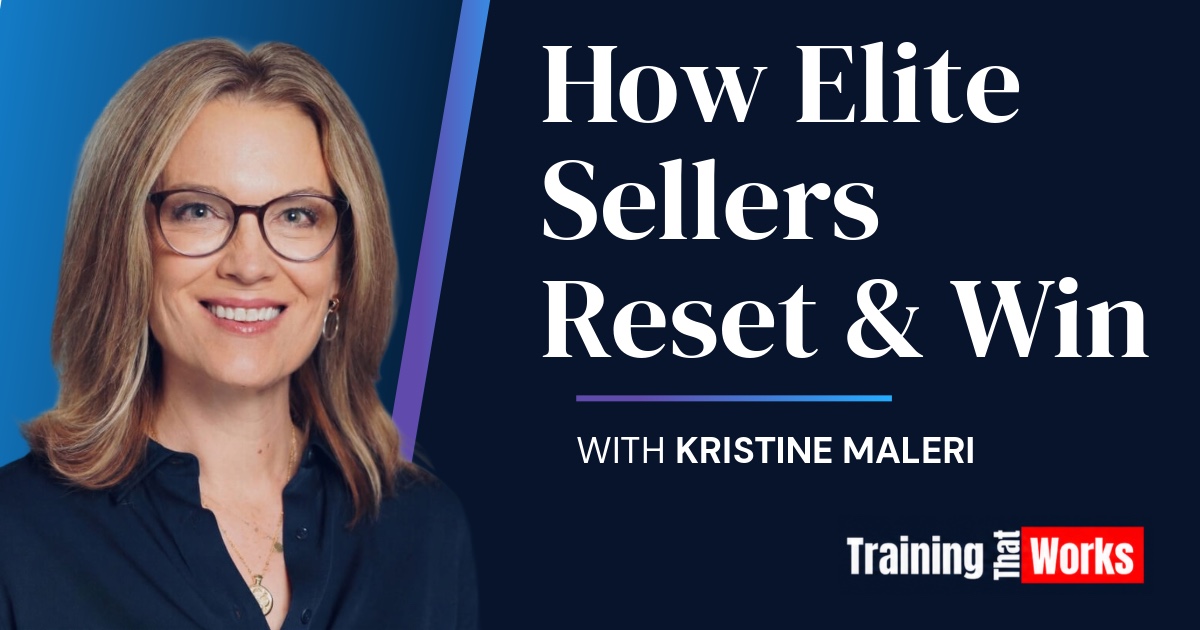
Rustin Schroeder · 00:00welcome to Training That Works. Today we're joined by Kristine Maleri, a seasoned enterprise sales executive with over 30 years in the sales and more than a decade in cloud SaaS. Kristine has been a top performing seller across multiple industries and market cycles. She's won President's Club multiple times and recently participated in the top performer Leadership Academy at Workiva. Known for creating strategic value and driving long-term customer impact. Kristine is fiercely competitive by nature and thrives on the relational side of selling. In this episode, Kristine brings a refreshingly honest and vulnerable perspective to a topic that many sellers avoid, bouncing back from a tough sales year. Drawing parallels from her lifelong experience as a competitive tennis player, she shares the lessons, mindset shifts, and execution reset that is designed to help her regain momentum in the new year. This is grounded in real conversation about resilience, fundamentals, and how great sellers respond when the scoreboard doesn't go their way. Kristine, welcome to the show. It's great to have you here.
Kristine Maleri · 01:06Thank you, Rustin. It's really great to be here. I'm excited about our conversation. I know you had reached out to me, I think it was early in the summer. yeah, the timing at that point, you know, maybe wasn't right. And here we are. And I think it's the way things tend to play out, right? This topic, the year ended in 2025. As you mentioned, last year was one of the toughest sales years in my career. It's really, that's a hard, difficult sentence to say.
Kristine Maleri · 01:36loud, right? So in sales, we're conditioned to talk about wins and rankings, etc. So that's really what I want to do today is address this topic, which I think kind of lives a bit in the dark shadows, understanding that even for top performers, tough years happen, right? So a down year really can teach us, I think, more about ourselves than we ever thought possible. It gives us that opportunity really truly to reset
Kristine Maleri · 02:06Refocus recreate momentum in a new direction And as you mentioned, I've been a competitive tennis player all my life And I think something that you learn early on in tennis, there's such an ebb and flow right? No match is perfect There are double faults, right? You lose a set you have to win the next one you have an offseason So I think what really matters is how you respond to the next point and just kind of taking that analogy into sales. And I think I wanted to share kind of a funny story. I have had a long and winding sales career. I've been in SaaS and tech sales for about the last 12 years. Prior to that, I had a long journey as a publisher's rep with Pearson when my kids were younger. But before that, my career actually started out with Deluxe Corporation. And for young people listening, they probably don't write anymore, most of us don't, right? But I was a sales rep with Deluxe Check Printers and I called on banks and credit unions in southern Indiana. And so early on, I really, discovered what my secret sauce was that I've been able to leverage my entire sales career. So I walked into a small community bank. The parking lot actually had, it said cars this way, horses this way.
Rustin Schroeder · 03:31That's fantastic.
Kristine Maleri · 03:33Right? So I had a paper contract in my briefcase and I was going in to meet with this bank president to get the contract signed. So I had never met him before. His assistant pointed me to his office. And when I walked in, the president was leaning back in his chair. had his cowboy boots on the table. He was smoking a cigar and eating a bag of Cheetos. So undeterred, I struck up a conversation with him and a few minutes later, I walked out with a signed contract. So I have learned and continued to really leverage that skill of developing immediate trusted rapport with all kinds of people that I've encountered throughout my sales career. And that's a strength I have. And in fact, my team, they call me the therapist. And it's truly what I believe has made me successful for so many years in sales.
Rustin Schroeder · 04:29Right. I think that's huge. Developing that trust and rapport. mean, even if someone is completely different or you're thinking, okay, he's got the cowboy boots up on the table, he's smoking a cigar and eating a bag of Cheetos. I mean, you wouldn't think that, you know, it's fantastic that you're able to have that conversation and just start building that trust immediately and then still walk out with a signed contract. think that is just absolutely fantastic. And I love the story too. It's a great visual. So thank you. As we dive into this, there's going to be, I know we have a few different areas we're going to go down. Can you give us some key takeaways that we're going to focus on for the audience and then we'll dive in?
Kristine Maleri · 05:08Absolutely. So so I think the first thing is right an off-year Bad year if you want to call it that right a poor year in sales. It's it you have to separate it I think as a person from your identity, right? So this this year is designed to provide you with feedback and I think something that Also is really important is is a slump a lot of times Is really that slight drift in execution, right? So it doesn't mean lost talent but it's that slight drift. So I think we talk about going back to Building repeatable habits and I think I listened to James Clear on a podcast the other day. I love his book Atomic Habits So he talks about right you don't rise to the level of your goals you fall to the level of your systems So I think really that when you know market Factors are coming into play and maybe your sales year isn't going the way you want It's really important to go back to focusing on the fundamentals. So fundamentals matter more I think when conditions are tough, not less. And that was a big, big lesson that I learned this year. But keep in mind, that doesn't mean you're broken or washed up. It just means back to that tennis analogy, right? You're in between points. You gotta quickly forget what's in the rear view mirror and how can I have that impact going forward?
Rustin Schroeder · 06:35Right, exactly. And I love how the first thing you said there is you separate from your identity. Your tough year isn't who you are. And I love that piece of it because I think that's really, really important. you you mentioned, so when you look back on the last year, what would you say are the biggest factors that made it such a challenge for you and your team?
Kristine Maleri · 06:57Sure, and that's really important. do, I am a specialist, so I work in a matrix sales team, sales environment. So our team, right, we win together, we lose together. There were certainly external pressures and factors that impacted sales this past year, know, market contraction in the field of sustainability, certainly with changing regulations. I think more fragmented competition, and that's always a part of being in sales, right? Lot, know risk-averse. I think a lot of our customers were saying can we get by with our current process? And so it kind of became more difficult to kind of paint a picture about the why behind making that additional investment Especially when we have this kind of market contraction But I think the sneaky stuff right when we think about the internal drift and how personally You know as a salesperson maybe when this these external forces start to come in play There might tend to be you kind of have that maybe slight drop of intensity Relying too much on comfort on your past successes Over reliance on late-stage deals. So I think these things are create they can creep in We think about tennis, right, and the slumps I've had in my career. It's not like we forget how to hit the ball. It's we get back on our heels, right? We're not forward on our toes. So if I think about it... in the middle of a really tough year, I think that is the time to double down on fundamentals, right? Go back to basic habits that led to your success in the past. And you you mentioned in the beginning, I have this really incredible opportunity to participate in the Top Performers Leadership Academy at Workiva in the second half of 2024 through On Point Leadership Academy, Amy Cohen and Payton.
Kristine Maleri · 09:07Borton they are fantastic I'm gonna make a shout out for them. Anyone out there who's looking to provide this type of really high caliber training for you know frontline salespeople for executives on Point Academy fantastic the program was really inspiring to me and taught me a lot and Amy who was my coach really talked to us about Doubling down on our strengths. So what makes you special as a salesperson, right? What is your secret sauce? And I think that's why I shared that story about the bank president. So for me, I'm an I on the Wiley DiSC assessment. So that's relational selling. So thinking about during that year last year is going back to leverage my current relationships, my network, and I've always taken really good care of my network. I stay in touch with former customers, but how can I use that to really drive deals forward in a tough market? How can I build and craft a true coach in that sales opportunity? How can our team help that will help us drive those deals forward or create additional trust and transparency with a key influencer in one of my opportunities? So those are some things I think.
Kristine Maleri · 10:31you know, really focusing on the basics and getting back to makes what has made you successful in the past.
Rustin Schroeder · 10:37Right. And I really like how you labeled it, the sneaky stuff, because that is so true. I it really is. It's things that can just sneak in there and, like you get comfortable. And then I really like your solution. Hey, double down on the fundamentals of what got you here. You know, that reminds me of like Vince Lombardi, the Packers coach. You you still win the Vince Lombardi trophy for the Super Bowl. And one thing he always did when he started the football year every year is he'd hold up the football and say, gentlemen, this is a football. And he would say and repeat that every year because that is like it is so fundamental and you have to go back to those fundamentals. So I love that you said that. So I think that's great. If you look back on this last year, what would you do differently that you think would have had the most impact on the end result?
Kristine Maleri · 11:29And then a couple of thoughts there and I guess if it's okay I wanted I guess to share another story and I think when I think about what I would have done differently and doubling down on those strengths is We talked about in sales, right the ability to create a true champion so and I think I think Rustin and I talked about this and preparing for today. I like this idea of workshopping the win
Kristine Maleri · 11:58And you think we don't do enough of this and I think you know, we talked about on my sales team as soon as that contract is signed There might be a small moment of celebration and then our leaders are saying, okay, where's that next deal coming from? So I think we all struggle. It's like wait a second. Can't we spend some more time celebrating this? But what I would like to do is carry that one step forward and talking about workshopping the win Because I think losses tend to teach us lessons but wins are where the real
Kristine Maleri · 12:28clues are, right? So how did our team, let's debrief on the win. Let's talk about how we got there, the steps in the process. How can we replicate what we did here to win these other deals that we have in the pipeline? So for example, the story I have is my team and I closed a deal in late 2024. We had a true champion that we had built. We worked with her side by side to build a business case and presentation. Several meetings led up to this, right? She needed to present this to the CEO for final approval. So we worked with her to really craft and carefully design this presentation. So she and I had a text relationship. I love to get to that point in a deal where I can text, we've kind of have this relationship established and this trust. So I knew she had her meeting with the CEO at 6 a.m. Mountain Time, right? The CEO was in Europe. So I was having my first cup of coffee anxiously awaiting looking at my phone and at 6:19 a.m. I got the text in all caps approved, right? So workshopping that win and thinking about the ability to really develop the champion We worked very carefully on creating, you know The value message aligned to what was important to the customer helping her build and craft that presentation and ultimately winning that
Rustin Schroeder · 13:39No way. Yeah.
Kristine Maleri · 13:58deal.
Rustin Schroeder · 13:59Right, right. that's fantastic. Now that we're in the new year, what type of action plan are you going to put in place to make this year an incredibly successful year for yourself?
Kristine Maleri · 14:12Yeah, that's, I'd love to talk a little bit about that. I think one thing that really stands out to me when I look back on the year is what did I stop doing that used to work, right? So, and we already talked about kind of workshopping the wins.
Kristine Maleri · 14:30I think fail faster. mean, I really in December when it became apparent on kind of how the year was playing out, I knew it was really important to get out of the gate quickly. So in December, I really began building a high level strategic plan for my territory, identifying, you know, those top priority accounts that I was, you know, I'm going to go after in the new year. So really the goal is starting out strong, starting out quickly. The goal, get as many meetings set up in January and February as possible to really drive that early momentum. Also going back to sales training that works. So our teams in 2025 participated in what's called Command of the Message training. something that I did in December is I spent some time really reviewing the notes from that course. I mean, this is an initiative that leadership invested a lot of money and time into and is a real focus for us going into 2026. So really kind taking a look at reviewing what I've learned through Command of the Message, what problems do we solve for customers? How do we specifically solve them? How do we do it differently or better? And where have we done it before? So as I was building out the strategic plan, thinking about the accounts I'm going to focus on and how I'm really going to weave that Command of the Message into my account strategy going forward into the new year. And then another thing is thinking about an area of improvement. Something that I struggle with is, or that I know I need to do a better job of, is negotiation.
Kristine Maleri · 16:26So I use the month of December again to say how can I really work on this? And so I began reading this book. It's called Never Split the Difference: Negotiating As If Your Life Depended On It by Chris Voss. He's a former FBI negotiator This book is excellent. It talks about strategies like mirroring and labeling and Getting a no getting a no I'd never thought about that but getting a no helps get you to a yes, so Again, I think it's important to think about areas of improvement. Continuous learning is really, really important to be successful. And so those are some of the things I'm really focusing on this year.
Rustin Schroeder · 17:05Okay. that's great. I really appreciate that and I just like how real you are on each of each of your answers. You mentioned the idea of failing fast and I really like that. Can you, can you give a strategy that you plan to use this year to do that?
Kristine Maleri · 17:22Absolutely, sure, Rustin. So one of my leaders, a VP that works really closely with our team, he has a great question. I learned so much from him. And this is a question that he taught us that I really plan on using on repeat this year in meeting with a customer and really trying to identify and understand their timeline and priorities. And I think that really can help our team understand whether this is truly an opportunity that's going to move this year. So question the question is for the customer is is this an idea? Is this a project or is this a funded initiative? So I think that really helps you get an understanding of you know how that team is prioritizing the decision and therefore you know how that opportunity is going to fit into your calendar and how your prioritizing working that deal. And that kind of goes back to what I said about failing fast, is I think it's important to kind of create that roadmap across your accounts of, you know, if we look across Q1 through Q4, how our teams are prioritizing their time and efforts across these opportunities, because your time is one of your most valuable assets, truly.
Rustin Schroeder · 18:46Right. And that's such a great point too, because there are many times a customer has an idea and you don't realize it's an idea. So you're spending all this time and then it's like, well, it's not really something we're going to dive into for a while or next year or whenever it is. But then if it's a funded project, that's a completely different thing. So I love the idea of separating that in the beginning so you can help them form the idea if they need help on that. then knowing for sure that it's a funded project or just an idea, think that's great. a great question.
Rustin Schroeder · 19:18So thank you. As we recap, can we recap some of the key takeaways? Because there's been a lot here and I think there's so much for the audience. What are the mission critical areas that you're focusing on to drive change and success this year?
Kristine Maleri · 19:36Yeah, so one thing I I follow Greg McKeown. I read his book called Essentialism. It's an excellent book and I was thinking about how I can apply this to my day to day in terms of, you know, really getting out of the gate strong in 2026 and having the ability to reset and refocus. So something I'm going to work on asking myself is what is the one thing today right that I can do to make everything else easier or necessary. So this idea of preserving energy and being strategic. So where can I delegate, delete or delay? So again, focusing on those top 20% of my accounts where we can deliver 80% of that revenue, right? So really that really strong essentialism and account level focus. Mastering a few core sales motions. So in discovery, really thinking about what are those two or three questions where we can consistently uncover pain with our customers. Customers love stories. Let's get that bank of repeatable stories built in. to our sales flow and sales process. So this idea of, think it was super important to create repeatable excellence rather than scattered activity. That's what I'm really focusing on. So Asking myself throughout the day. Is this the highest value use of my selling energy? right now because we only have so many hours in the day and we only have so much energy so Really spending energy on where you win and so in December again that strategic planning is really that beginning of Focusing on where am I gonna spend that energy? So you want to really create that predictable repeatable? to success. And then also I think build that recovery time in thinking about you know I work I am on site with customers but also work remotely those quick breaks during the day to give yourself in your mind kind of a chance to reset I think is super important. But the goal of this, think, really that confidence is going to come back when you have that strategy on making the execution more predictable. That's kind of a key takeaway for me as well.
Rustin Schroeder · 22:06Right, I like that. And two things there that I really liked is the stories piece of it. Having stories that you can go back to with your customers, that makes all the difference in the world. You know, because just the numbers and the game as it is, is difficult. But when you add stories in it, it really adds so much color and so much like, it's a game changer, it really is. And I love your phrase, repeatable excellence. because I think that is a piece that a lot of people miss. That excellence piece is what separates. And I think I love how you said repeatable excellence. So thank you for sharing that. Yeah, yeah. So you've been in this game for 30 plus years. What would you say is the one thing most people don't realize about your journey? I mean, because people look at you and they see you and they see, all right, you've been successful. You're here now.
Kristine Maleri · 22:46you're welcome.
Rustin Schroeder · 23:02Like what is the one thing people don't realize about your journey that you would like them to know?
Kristine Maleri · 23:07Yeah, another vulnerable story I guess I'll share. Well, first of all, I started out as a sports communication major. So obviously I grew up playing competitive tennis. I still play. I am obsessed with sports. I love watching sports. I talk about sports and probably no more than my female friends tease me about that. So obviously I pivoted. I did not become a sportscaster. So I got into sales and
Kristine Maleri · 23:37My very first manager, and I'm not sure where he is now, but after three months, he pulled me in his office and he said, Kristine, I just, I gotta be honest with you, I don't think that you're gonna amount to a salesperson and you might wanna rethink about pivoting, shift.
Kristine Maleri · 23:55And so I look back and that if anyone knows me, I think my mom would agree. I am stubborn and competitive. And that was exactly just like the kindling, the fuel to the fire that I needed to hear to prove him wrong. So I don't know where you are today, Tom, but I would say that it's been a really amazing and wild ride. I've loved all the people I've met along the way in every industry I've worked in. I've built so many great customer relationships. still stay in touch with many of my customers. I've learned so much from them. I love helping people solve problems and I think that's helped lead to my success. I would just say sales is a long game for those of you listening that have been in sales a long time like myself or just for those that are starting. I have two young adult children that are just starting their careers in sales. So if you stay in it long enough, I mean, you're going to get knocked down. So I think what really matters is how intentionally you stand back up, right, and how you choose to play that next point.
Rustin Schroeder · 25:06Right. And I love that you took that comment that, you know, could be a devastating comment, a very hurtful, and used it as fuel to say, no, this is not correct. And I'll prove you wrong. And I love that you said you used it as fuel to keep going. I think that's great. So thank you for sharing that. I love the passion you have here. This has been a great conversation and a great time talking to you. As we close, do you have any words of wisdom or remarks that you want to share with our audience before we close?
Kristine Maleri · 25:36Yeah, absolutely and kind of bringing this conversation out from the dark shadows, right? I hope if it has an impact just on one person I mean that was really the goal of this conversation. So you are not broken right? You are not your sales number I mean, this is really an opportunity again for growth. It's it's a reset I think if you look at it as an opportunity get back to the basics double down on your strengths and and the goal isn't to get back to who you were before because I think we're always moving forward. We're always changing, learning, and growing. It's really to become more intentional, disciplined, and resilient. And I think these types of years, when done correctly, it's just that opportunity to try things, to do things a little bit differently and really develop more resiliency.
Rustin Schroeder · 26:29That is fantastic. I really, really appreciate you joining the podcast. This has been an amazing conversation. And one, think that people are going to listen to more than once, maybe many times, because there's just a lot of great information in here and that can really help people grow. So Kristine, I really appreciate you being here. Thank you for joining the Training That Works podcast.
Kristine Maleri · 26:49Thanks so much for us then it was just a pleasure to speak with you and I know we will stay in touch

 Apple Podcasts
 Spotify
 Amazon Music
 RSS Feed